Raise a Glass as We Say, “Cheers, Wanda!”
Tasteful Croatian Journeys is thrilled and delighted to announce that Condé Nast Traveler has once again named Ms. Wanda S. Radetti, president and founder of Tasteful Croatian Journeys, a ‘Top Travel Specialist’ for Croatia.
Raise a glass as we say,
“Cheers! Facciamo Un Brindisi! Živjeli, Wanda”

Wanda S. Radetti has been recognized as a top specialist for Croatia by Condé Nast Traveler magazine every year since 2006.
2021 marks her 16th consecutive year receiving this honor.
See Wanda’s Condé Nast Traveler profile here.
We Asked Wanda to Comment:
Grateful, I am Grateful!
It all started with a ‘journey home to Istria & Kvarner’ for the Histria Association of Women more than 25 years ago. From there, enormous growth, both personal and professional, and a never ceasing feeling of wonder and gratitude have led me on the path to where I am today.
Condé Nast Traveler’s ‘List of the Best’ is the seal of approval and the pat on the back that is my inspiration.
The pleasure of composing outstanding travel interludes for some of the world’s most sophisticated travelers is priceless and a responsibility that I take very, very seriously. The recognition is a true honor for which I will forever remain very grateful…
Fifteen years ago, on a Sunday afternoon of the summer of 2006, I spent the most life-changing afternoon on the phone with one or two of the Condé Nast Traveler Editors. From the posed questions, I learned much, but more importantly, I developed new thoughts and ideas that have guided my professional life in ways that I could never have dreamed or imagined.
Just a few months after my very interesting interview on that Sunday afternoon, I received a call from Mr. John E. Curby and his wife. They told me that they found me on “THE LIST.” That is when I realized that I was invested with an extraordinary responsibility to justify the choice that Condé Nast Traveler made when I was listed as the first ever World Specialist for Croatia.
I am honored to be one of the “par excellence list” that collects some of the most amazing travel professionals In the World. I am grateful for the reliance that Condé Nast Traveler continues to express about my craft.
Over the years, I have referred many of my clients to the extraordinary destination specialists with whom I share a place on the Condé Nast Traveler list, requesting my colleagues’ attention for their specific specialty. Whether traveling to Portugal, Morocco, Japan or Vietnam, every traveler that I have sent their way has benefitted from the care, knowledge, experience, and excellence in service expected from those bearing the Condé Nast Traveler seal of approval.
To those special travel professionals, I say, thank you, dear friends, and congratulate you on your achievements. Each of you at some point has been an inspiration, a sounding board, and a friend. How happy I am to be on this journey together!
My dear old friends, I miss you, and I look forward when again an embrace is not just a word but a tangible expression of admiration, care, and affection.
To the extraordinary specialists that have recently joined “the list,” welcome!
Between me and you, my secret ambition and my wish are that every traveler that I serve will consider my team and me as their personal “caretakers of wonder,” opening doors to curiosities and discoveries they never could have imagined before.

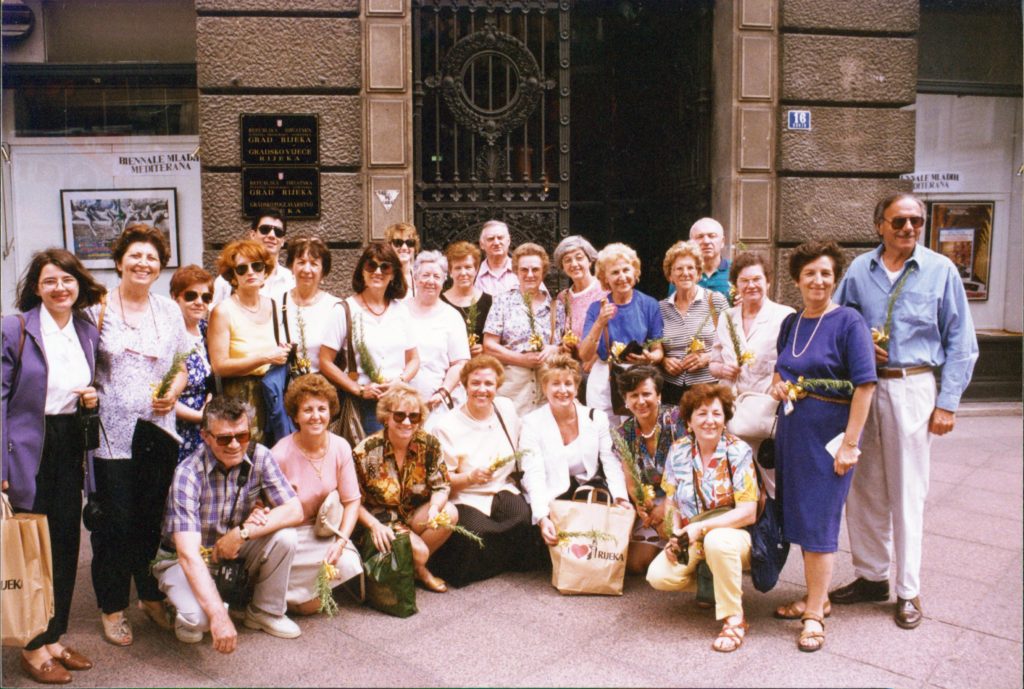
The Histria Association for Women on their “Tasteful Istria and Kvarner Journey” in Rijeka, Croatia, 1995
About Wanda and Tasteful Croatian Journeys
In 1994, when Wanda S. Radetti, the CEO and founder of VisitCroatia.com/Tasteful Croatian Journeys, explored designing and marketing five-star travel to Croatia, the national press referred to her approach as “avant-garde”. “Premature” would have been a more accurate reference. Croatia has come a long way in the last twenty years and is now considered a World Class Travel Destination.
Wanda and her team of passionate professionals create custom itineraries like a composer arranging a musical masterpiece, collecting notes about each individual client’s desires and needs and forming them into a harmonious journey of a lifetime. As a consistent honoree of Condé Nast Traveler’s “World Top Travel Specialist for Croatia” since 2006, her expertise and passion for Croatia is unparalleled. Wanda aims not only to create unforgettable experiences for her travelers but also to form a network of personal relationships along the way. Each year, Wanda conducts multiple site inspections in the country to hone and update her extensive knowledge of Croatia.
Having organized some of the earliest luxury travel from the United States and around the world to Croatia—before it became a “hot, new destination”—Wanda has overcome political barriers and views borders as opportunities to build bridges of friendship and cultural exchange. For the sophisticated, educated traveler, she opens up a little-known country to reveal her deep insights into its untainted natural beauties and ancient local traditions.
Mljet: An Island to Remember
Mljet has long been one of Croatia’s most alluring islands; a verdant escape home to unspoiled nature, surprising history, rustic villages, picturesque beaches, and an air of tranquility unrivaled in Dalmatia. Yet somehow, this paradisical island remains largely off-the-beaten-path, sharing its charms only with the select few who venture to its shores. Tasteful Croatian Journeys invites you to delve deeper and discover Mljet’s secrets. Our Luxury Travel Designers have teamed up with local guide Michelle Ramonita Rodriguez Stražičić to explore Mljet’s unique legends, landscape, and culture. Together, we’ve put together this insider’s guide to what to see, do, and eat on Croatia’s greenest island.
About the Island of Mljet
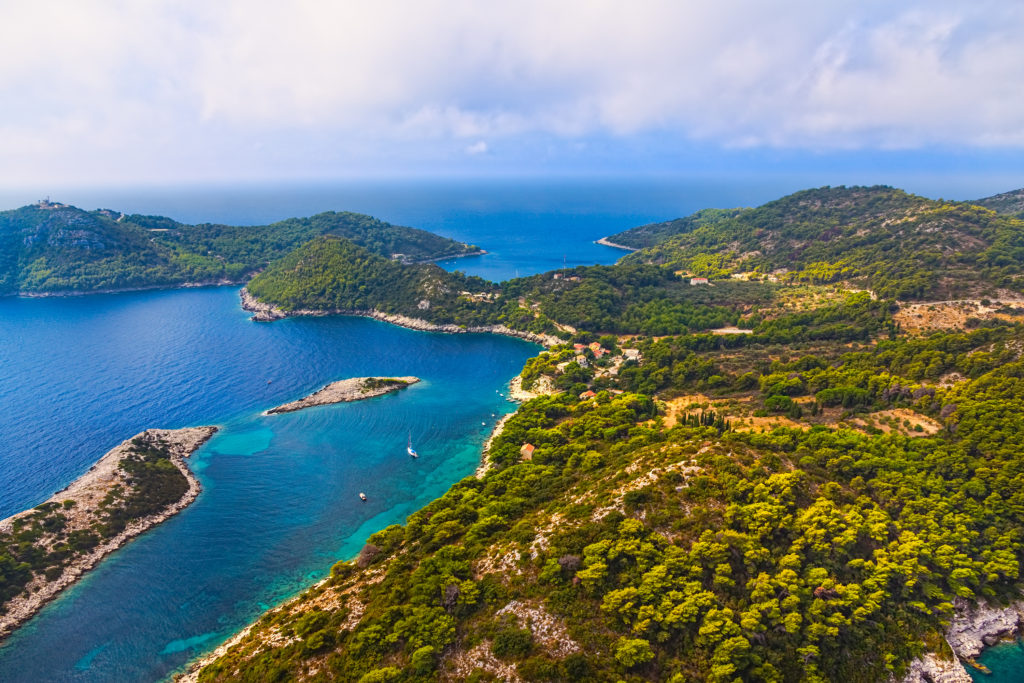
Located in southern Dalmatia, between the coastal city of Dubrovnik and the island of Korčula, Mljet is the eighth largest Island in Croatia. It is nicknamed the “Green Island” due to the rich forest of Alepski Bor (Aleppo Pine) that extends from the sea’s bed to the highest point of the island’s surface. The Aleppo Pine was brought to Mljet from Alepa (Israel) before the time of Christ. The sap of the trees produces an aroma that is hypnotic, especially for first time visitors. It is a perfume which scents the air across the island.
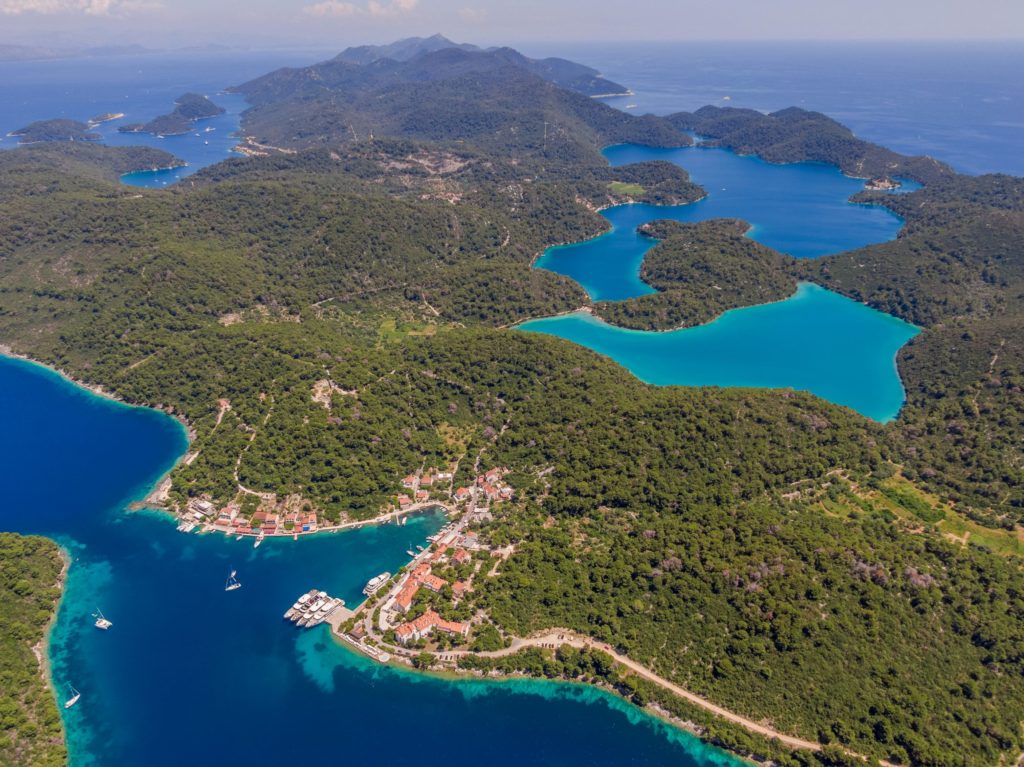
Mljet’s main attraction is its National Park, which occupies the western part of the island. Here, visitors will find pristine natural beauty; untouched and protected. In the center of the park lie two enchanting cerulean saltwater lakes, Veliko Jezero and Malo Jezero (Big Lake and Small Lake). In the middle of the large lake lies the small Isle of Saint Mary, home to a 12th-century Benedictine monastery. Around the lakes, a blanket of thick forest stretches across the island interrupted only by olive groves, vineyards, and a handful of tranquil settlements.
Just off the coast, numerous shipwrecks and sunken Greek amphora hint at the island’s history. It is said to be Mljet, not Malta, which is the island “Melita” on which Saint Paul was shipwrecked. Similarly, it is Mljet, not Gozo (off the coast of Malta), which claims to be the mythical island of Ogygia described in Homer’s Odyssey. On the southern shore of the island, not far from Babino Polje, the island’s largest settlement, travelers can visit the limestone cave believed to be where Odysseus drifted after his shipwreck. There, he came across the beautiful nymph Calypso, who held him captive for seven years until his release was ordered by Zeus.
Exploring Mljet National Park
Set out for the western side of the island!
Independent travelers will find that Mljet is well connected to the mainland and other islands by public ferry and catamaran, making it an ideal single day excursion from both Dubrovnik and Korčula. Tasteful Croatian Journeys can also arrange private yacht and speedboat excursions for those seeking added comfort or flexibility.
The recommended ports of arrival for those planning to visit the national park are Pomena or Polače. During the summer, the small fishing village of Pomena functions as the island’s main city, with plenty of waterfront restaurants serving tasty local cuisine. It is also home to the island’s longest-established hotel, the Hotel Odisej, a comfortable three-star property which is part of the Adriatic Luxury Hotels collection.
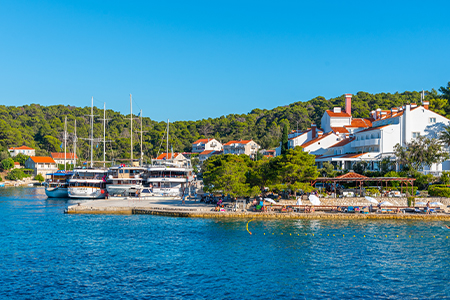
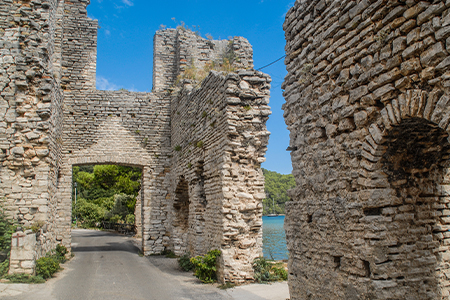
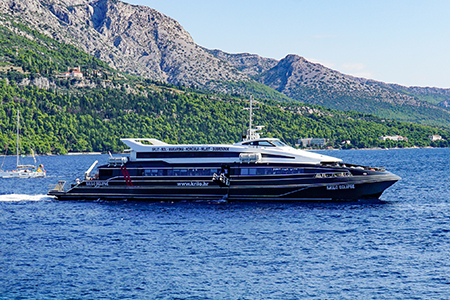
Two miles away, the ancient trading port of Polače still holds remnants of the past, including the ruins of a Roman palace which date back to around the 5th century. Polače was known to be the safest port on the eastern side of the Adriatic, featuring a large bay sheltered by four small islets. Today the village is home to just over one hundred residents and has several restaurants and cafés.
Either village serves as an ideal starting point from which to explore Mljet National Park independently, by foot, bike, or kayak. Your Tasteful Croatian Journeys concierge is available to arrange bike, canoe, and kayak rentals. Together with Michelle, we can also arrange organized tours to explore the island’s cultural sights, such as the Odysseus Cave. As a resident of the island and professional in the hospitality industry, Michelle is able to put her local network and resources to work to facilitate the needs and wishes of our travelers.
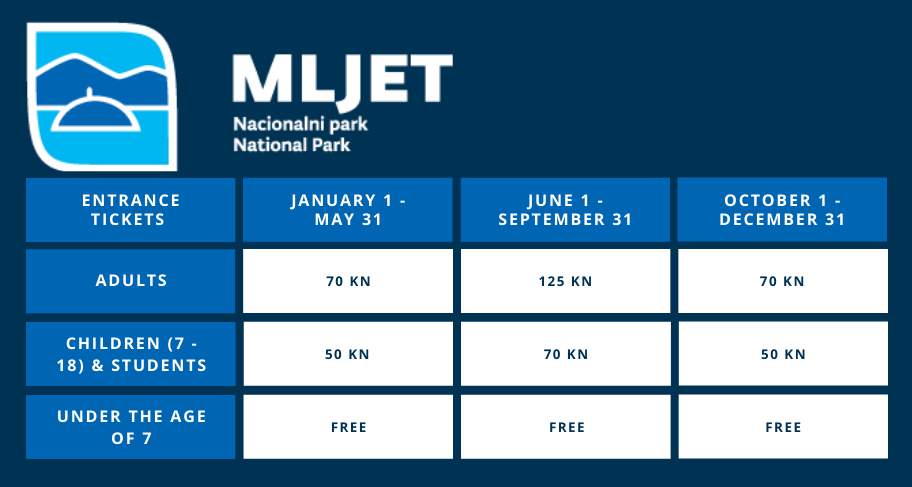
When arriving, visitors must keep in mind that a third of the Island is protected territory and purchasing National Park entrance tickets is a mandatory step of the journey. As there is no official entrance to the park, tickets can be purchased from kiosks located in both Pomena and Polače, or in advance from the national park’s online web shop. The Kiosks also offer park maps and boat timetables.
The entrance tickets to the National Park include services for your entire stay on the Island, whether that is for one day or multiple days. Prices can be found above, listed in local currency (Kuna).
Included in the entrance ticket are:
- The transfer from Pristanište (Mljet National Park Headquarters) to the village of Polače (home to an Ancient Basilica and Roman Palace).
- One boat ride to the Island of Saint Mary and back.
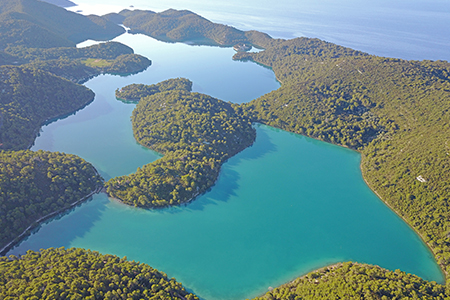
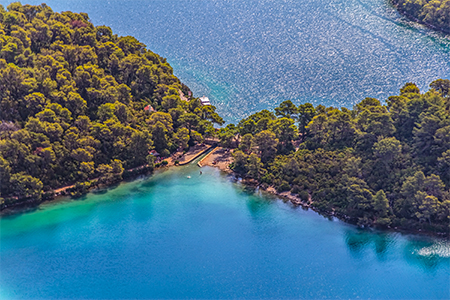
Once you’ve got your tickets, begin making your way toward the park’s main attraction, the saltwater lakes, Veliko and Malo Jezero (Big and Small Lake). There are lovely wooded trails leading to the lakes, and walking paths which encircle them. However, travelers with mobility issues should be aware of the moderate incline and occasional steps encountered.
Both lakes are home to many curiosities. The island is of volcanic origin, and the lakes were formed more than 10,000 years ago. Although the lakes link to each other through a small channel, and to the sea by a larger channel, they have a unique ecosystem all their own. In fact, a special species of jellyfish (part of the Aurelia genus) was found to be living in the lakes. The species is more than 24 million years old and cannot be found anywhere else in the world. However, travelers needn’t worry as it is harmless to humans. In addition, the Big Lake is home to the largest recorded bushy coral reef (Cladocora caespitosa) in the world. The bushy coral, also known as Mediterranean pillow coral, provides a place for fish and crab spawn to hide, protected from the current. Many species of sea life rely on the natural rotation of water in and out of the lakes. This, coupled with the fact that the lakes are often several degrees warmer than the sea, make them a wonderful place to swim and snorkel.
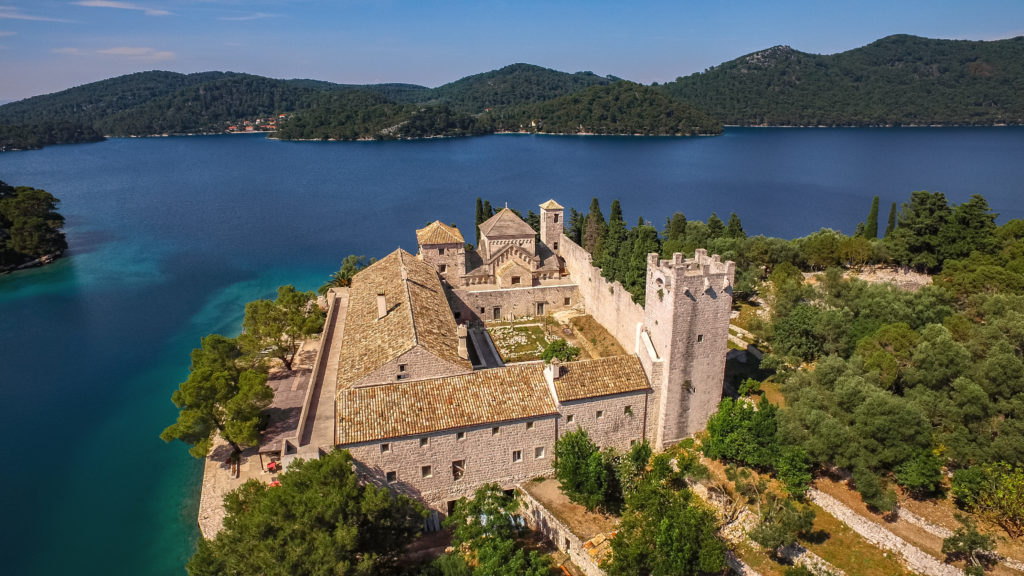
After swimming and exploring both lakes, take the boat to the Isle of Saint Mary (also sometimes referred to as Islet Melita). Pick up points are located at Mali Most (Small Bridge) and Pristanište. This tiny island in in the southern part of the Big Lake is home to one of the oldest church complexes in the Adriatic. Here, built atop ancient Roman ruins and surrounded by olive trees, the 12th century Benedictine monastery and the Church of Saint Mary stand as a proud symbol of Mljet’s storied past.
The monastery, which was built in the Romanesque style, but later saw Renaissance and Baroque additions, has had many owners and served many purposes over the years. It played home to many great artists and poets, including famed Baroque writer Ignjat Đurđevic.
The monastery temporarily fell to disuse under the rule of Napoleon before being brought back as the office of the Forestry Administration under Austrian rule. In the 1960s, it began a brief stint as a hotel before eventually being closed and returning to the control of the Diocese of Dubrovnik. Today, the monastery is in the process of being restored to its former glory, and houses a café and restaurant, Restaurant Melita, which serves authentic Dalmatian cuisine. Visitors can enjoy a meal or refreshments there before exploring the islet and church and meeting the islet’s two resident donkeys, Melita and Ante.
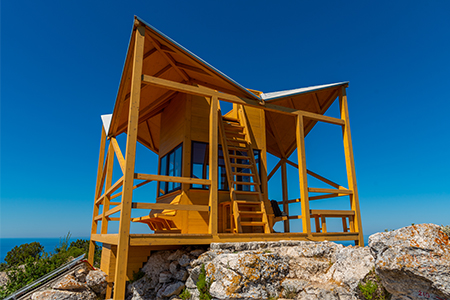
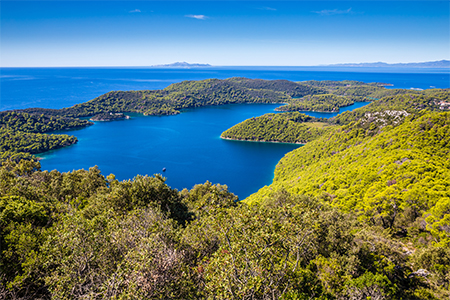
From the Big Lake, a hiking path leads to the scenic lookout point of Montokuc, a 770 ft peak located in the center of the park. This moderate hike is well marked, winding through the forest along a dirt path, eventually opening up to reveal spectacular panoramic views of the island, its lakes, and Pelješac and Korčula beyond. Viewing the park from this vantage point is the best way to truly appreciate just how vibrantly green Mljet is.
If this 2.5 mile round trip hike isn’t enough, consider the 27 mile long Mljet Hiking Trail (Mljetska planinarska obilaznica, MPO) that spans more than half of the island. The route is split into shorter segments, each meant to take from 5 – 7 hours of hiking, designed to be completed in succession over 3 – 4 days. The entire trail is clearly marked with 20 control points along the way.
The route segments are:
- Pomena – Goveđari
- Goveđari – Blato
- Blato – Rogovići – Babino Polje
- Babino Polje – Veliki Grad – Sobra
In addition, there are as many as eight gravel trails and one asphalt trail that are available to visitors who prefer to explore the park by bike.
Mljet Beyond the Park
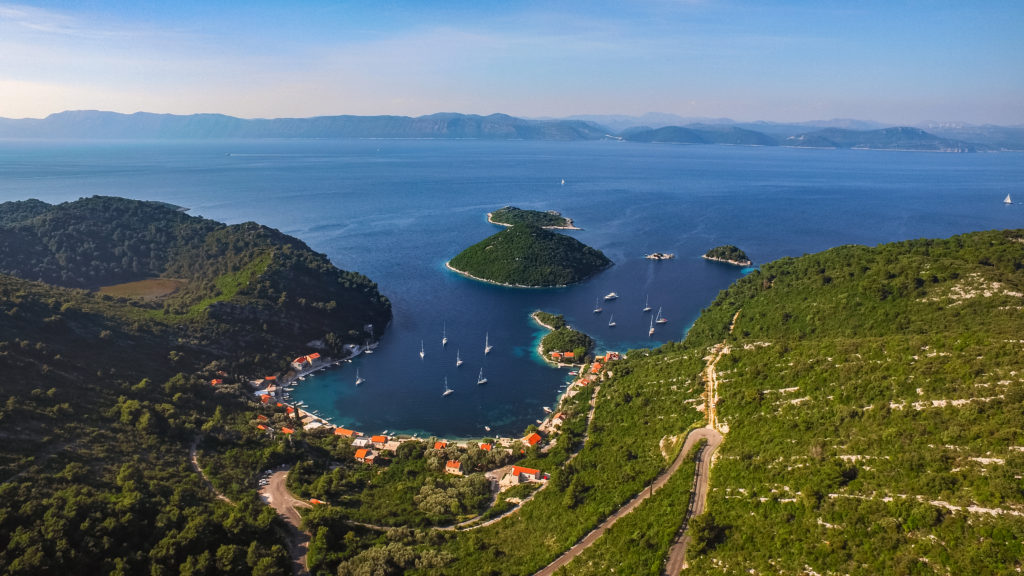
To get the full Mljet experience, venture beyond the national park to the eastern part of the island, where a smattering of quiet villages and pristine beaches beckon travelers to explore. A single two-lane road runs the length of the island, connecting the settlements which house the island’s population of roughly 1000. In some ways, a trip to Mljet is like a trip back in time. Nature and island life exist in harmony, the people living off the land and sea.
At one point, the island was overrun by poisonous snakes, but in 1910, while under the rule of the Austro-Hungarian Empire, small Indian mongooses were introduced which effectively wiped out the snake population.
On the south side of the island is the cave where Odysseus is said to have been shipwrecked and held captive by Nymph Calypso. The cave can be reached by a somewhat challenging hike from Babino Polje, the island’s largest settlement and administrative center, followed by a short swim. It can also be reached much more comfortably by small boat. A private boat excursion to the Odysseus Cave can be arranged by Tasteful Croatian Journeys. Michelle recommends visiting the cave just around noon because of the beautiful spectrum of colors created when sunlight floods the cave, making it feel as though Calypso has returned. After seeing the cave, it is only natural to wonder if Odysseus was truly trapped for seven years, or simply so struck by beauty that he decided to stay.
Mljet is also home to some of southern Dalmatia’s most beautiful sandy beaches. In fact, the village of Saplunara, at the far southeastern end of the island, takes its name from the Latin word sabalum meaning sand. Just beside the settlement, two sandy beaches, a larger and smaller one, can be found in a tranquil pine-rimmed cove. Just a short walk away, another stunning sandy beach, Blace, serves as an isolated oasis for travelers seeking serenity and relaxation.
Where to Eat on the Island of Mljet
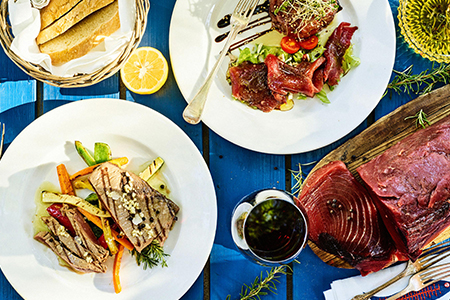
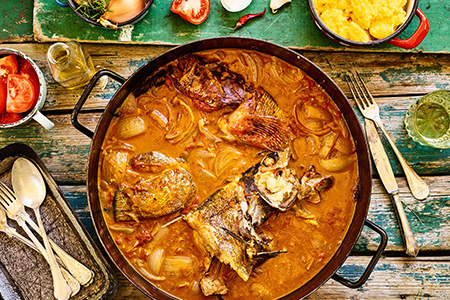
Finally, before leaving Mljet, be sure to indulge in a traditional Dalmatian meal. The cuisine of Mljet is a reflection of the islands’ resources and centers around the fresh ingredients grown or sourced from the land and sea. Fresh fish, octopus, and shellfish, local olive oil, wild herbs, and goat’s cheese are all staples. Dishes range from simple grilled fish and meat to unique local specialties such as Mljetski Makaruli (a handmade local pasta topped with olive oil, goat cheese, thyme and garlic) and Zelena Menestra (a chunky soup made from collard greens, potatoes and pork).
“While on Mljet, whether on a bike ride around the lakes, visiting the monastery, rediscovering the basilica and roman palace, hiking through pioneer routes or adventuring out to the Odysseus Cave, remember that Islanders’ including myself know how to eat. Each and every village in the area of the national park gives their heart and soul to hospitality. What we catch is what we eat.” – Michelle Ramonita Rodriguez Stražičić
Here are some restaurants Michelle recommends around Mljet:
Konoba Antika
Location: Polače
Popular among sailors, this traditional waterfront restaurant serves up hearty local cuisine at reasonable prices. Order at least 3 hours in advance to try the octopus peka, a traditional dish slow-cooked on a hearth under a metal dome.
Restaurant Pomena
Location: Pomena
This family run restaurant with spacious outdoor terrace is conveniently located near the docking point of the public catamaran. The menu features a wide array of fresh, simply prepared fish dishes – ideal for seafood lovers!
MS Restaurant & Bar
Location: Saplunara
Located in the far eastern part of the island, near the beach and surrounded by pine trees, MS Restaurant offers plenty of atmosphere. The menu is comprised of a variety of meat and fish dishes prepared using both local and international culinary techniques.
Stermasi
Location: Saplunara
Situated on a hill overlooking the water on the eastern side of the island, Stermasi is well known as being one of Mljet’s best restaurants. The specialties here are seafood of all kinds, as well as goat. Their olive oil is homemade and can be purchased by the bottle.
Interested in visiting the island of Mljet? Contact us for more information and to begin designing your custom itinerary to Croatia.
About the Authors:
This article was the result of a collaboration between Tasteful Croatian Journeys Luxury Travel Designer and Destination Specialist, Tia Lovisa Moreira, and Mljet locals Michelle Ramonita Rodriguez Stražičić and her mother Ane Stražičić-Rodriguez. Michelle studied International Hospitality and Service Management at RIT Croatia in Dubrovnik before moving to her ancestral home of Mljet to work in the tourism industry. She and her mother are passionate promoters of their Island, Mljet.
You can learn more about them, their family history, and their connection to the island of Mljet here.
The Best Souvenirs from Croatia
sou·ve·nir
/ˌso͞ovəˈnir/
noun
A thing that is kept as a reminder of a person, place, a special moment, or event.
I was five years old when I bought my first souvenir while traveling. I experienced my first “solo” travel (not with my family) to the Adriatic beaches of Rimini from the refugee camp of Laterina. My mother had to add a few years to my actual age to receive permission for me to travel. In Rimini, I fell in love with the beaches, and the sea, the Adriatic Sea. In a little shop on the boardwalk, I found my first souvenir. I had money in my pocket. My father gave me a few hundred liras, “just in case”. Just in case, for me was a different gelato flavor for every day of the month.
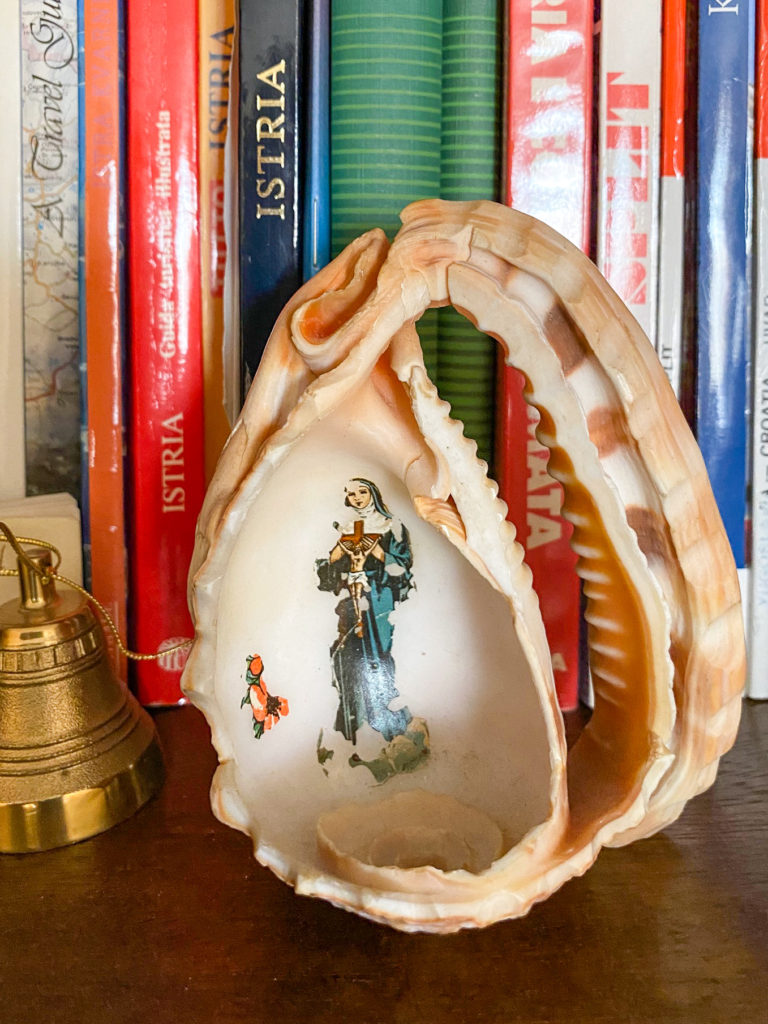
But a particular “Just in case” happened a few days before my scheduled return home. On my way to the gelateria, I focused on the small shack on the boardwalk that sold all sorts of colorful beach toys, straw hats, wooden zoccoli, bathing suits, postcards, magazines, newspapers, and souvenirs. It was the shell of a conch cut in half, with the image of Santa Teresa Delle Rose pasted in the interior that called my attention. I did not have a favorite Saint. I knew little if not nothing of Saints, but it was that shell that I was told to hold close to my ear when I returned to the refugee camp to continue to enjoy the seductive murmurs of the Adriatic Sea. As a little girl, I regularly fell into dreams while holding the shell close to my ear. Many decades later, I still look and smile at that shell that today has a place of honor on my bookshelves.
The lure of places to me unknown, the pleasure of making new friends, my curiosity and quest for adventure, the desire to make many travel dreams come true, led me to fantastic discoveries and spectacular friendships around the World.
When my life directed me to “go home” to Fiume, now Rijeka in Croatia, I was enchanted by my discoveries of the places that spoke to me of my mother’s memories when I was a young girl. I loved her stories, but sometimes I had wondered if her romantic nature might not have illuminated the brilliant memories of the places and people she described to me.
Then it was my turn to fall in love with Croatia. I fell in love, fell in love with Croatia, splendid, beautiful, romantic, extraordinary Croatia. I no longer wondered about the clarity of my mother’s memories. My love affair with Croatia is confirmation that my mother was a romantic and that her stories were not wishful exaggerations.
And that is when and how the story of my Tasteful Croatian Journeys started.
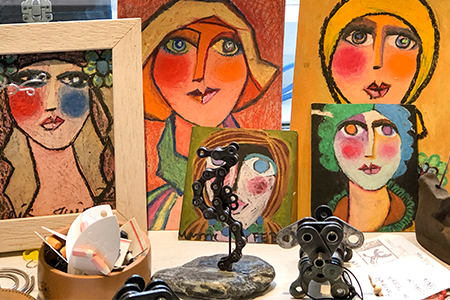
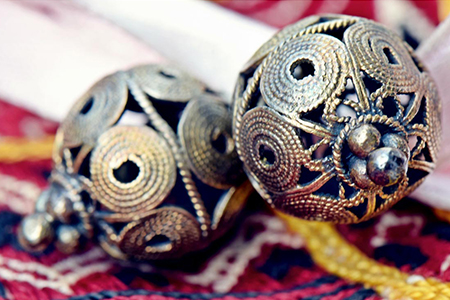
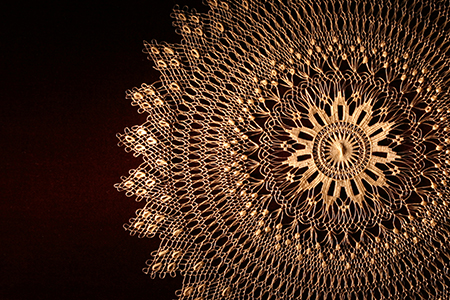
When you visit a country that you fall in love with, it is instinctual to want to bring it home with you, in any form: Music, flavors, books, traditional jewelry, embroideries, local crafts, and art.
In the first years of my journeys to Croatia, I too followed my instinct. I collected things that I would hold as memorable souvenirs of special travel moments. I, too, now have many beautiful stories in my “favorite memories drawer” as well as things that I love that remind me of my travels: Hand-embroidered tablecloths and lace decorate my dinner table for my friends’ enjoyment—memories of evenings of wine as I watched the sun’s descent into my Mare Nostrum. Music notes make me sway and dance in my living room as I relive that dance with that special someone, under the stars on the elegant terrace of the Hotel Kvarner in Opatija.
I no longer collect “things,” but my senses, individually, continue to collect special memories of Croatia that I hold very dear: Sublime visions of the spectacular panoramas of the Adriatic, the hill towns and olive groves of Istria, the vineyards of Pelješac, the wetlands of the Baranja region of Croatia, Vivaldi in a small chapel built in the 13th century, that now stands hidden in the middle of a forest, the intermittent scream and howling of Bura, my favorite wind, the perfume of the earth of Istria in springtime, the benevolent caress of the Mistral in the late afternoon of August. The aroma and pleasure of the precious ruby red Teran made by the little winemaker down the road from Hum, the smallest town of the world, the succulent oysters on Saint Joseph day in the bay of Ston, but, most importantly, the generous kindness and embrace of the friends to whom I will always be grateful and will hold dear, dear in my heart.
After all, if you know me, you know that I know that travel is all about people, wonderful, kind, interesting, beautiful people. People who go, people who arrive, the people who offer welcome to travelers, and the people who, with blessings, embrace the traveler goodbye.
~ Wanda S. Radetti, one of the caretakers of wonder of Tasteful Croatian Journeys
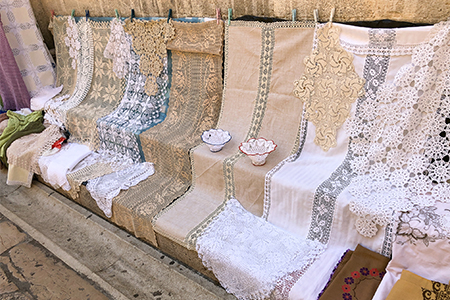

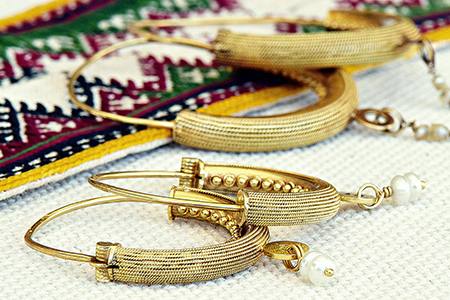
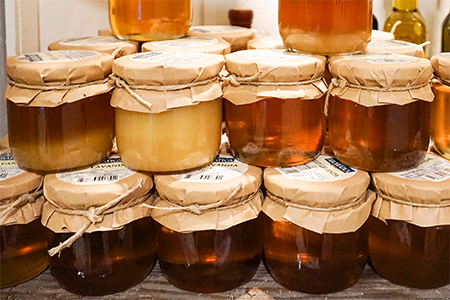
Our Team’s and Travelers’ favorite Souvenirs from Croatia
In rummaging through her “special memories drawer,” Wanda posed the question:
What makes the perfect souvenir?
It is a question as unique and personal as each individual traveler. From functional items made for everyday use, to sentimental keepsakes that evoke cherished memories, to one-of-a-kind conversation starters, the best souvenir is always something that is meaningful to you.
We’ve polled the Tasteful Croatian Journeys team and some well-traveled friends asking them to weigh in on their favorite gifts and purchases from their travels to Croatia. Here’s what they’ve got to share…
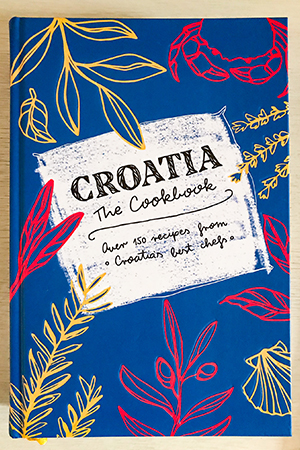
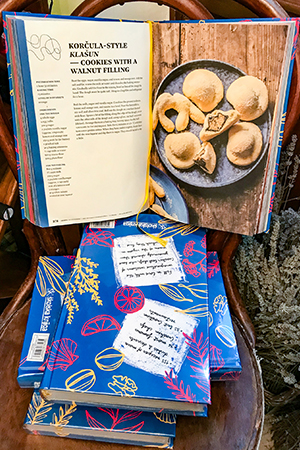
A Taste of Croatia Back Home
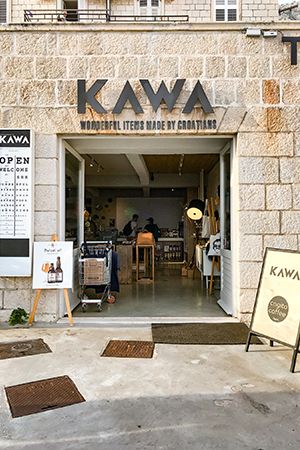
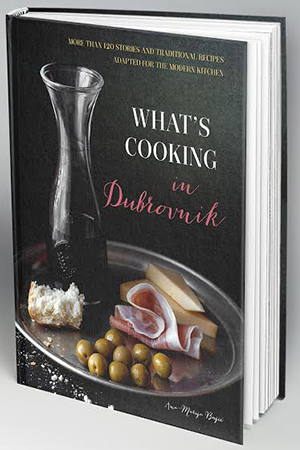
“Food is a huge part of travel for me, and my husband and I really enjoy trying to recreate our favorite meals from our trips once we’re back home. It’s a great way to relive some of our vacation highlights and keep our memories fresh. For this reason, my favorite souvenir is a good local cookbook – in English, of course! I have two great cookbooks that I’ve picked up in Croatia. The first is “Croatia: The Cookbook,” by Mate Janković, which was actually a gift from Wanda on my first trip to Korčula with TCJ. This big, colorful cookbook highlights recipes from renowned chefs all over the country. It’s a wonderful reminder not only of Croatia’s cuisine, but also of some of the talented professionals we’ve met there. The other cookbook I love is “What’s Cooking in Dubrovnik” by Ana-Marija Bujić, one of the owners of acclaimed Pantarul Restaurant. I purchased the book in quirky design shop, Life According to Kawa, just outside Dubrovnik’s eastern gate. The shop is entirely dedicated to products made by Croatian designers and artisans, and everything they sell is extremely high quality. Even if cookbooks aren’t you’re thing, you’re sure to find a great keepsake at Kawa!”
~ Tia Lovisa Moreira, Luxury Travel Designer
Perfect Pairings with Croatian Wine
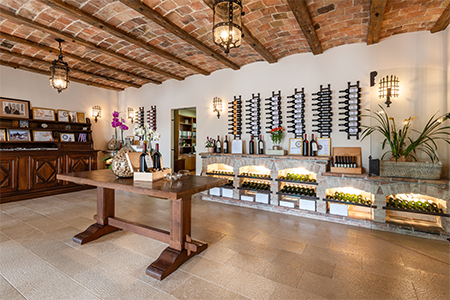
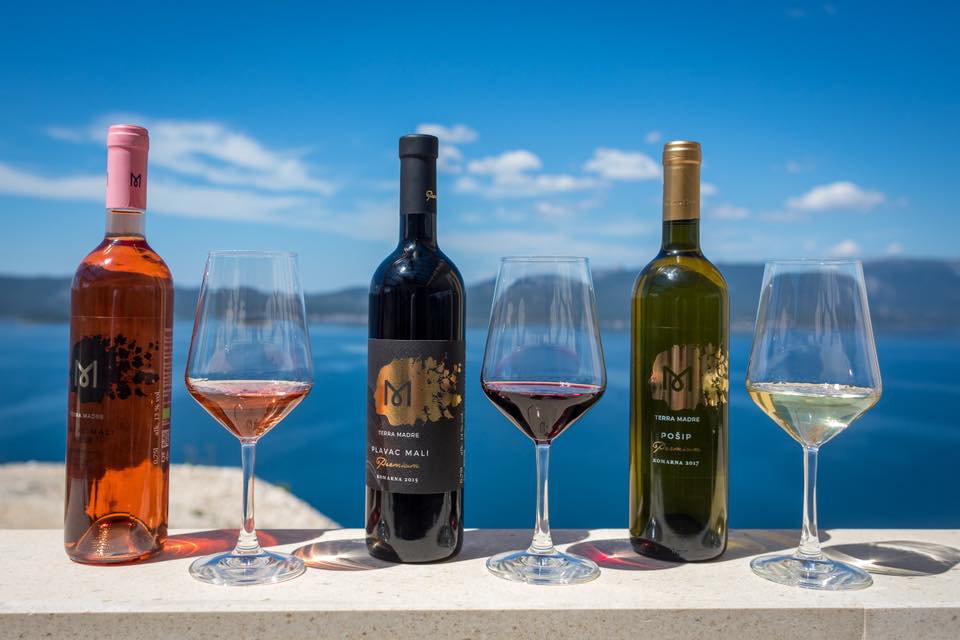
“With more than 130 indigenous grape varietals, what could possibly be a better souvenir than a bottle of fine Croatian wine? Many sommeliers suggest pairing traditional meals with local wines for the best gourmet experience, which is why a bottle of wine makes the perfect accompaniment to a Croatian cookbook. If you plan on cooking Croatian meals at home, my recommendation is to bring a bottle or two of indigenous Croatian wine back home with you; which can easily be purchased at the airport. Open a bottle and enjoy tasting while you explore the cookbooks to choose a recipe that you think will pair well. You may be surprised by what you find! For example, the indigenous variety Pošip is well known to pair well with seafood. But often, after people start experimenting, they realize that with Pošip, a grilled chicken or even a Thanksgiving turkey can also be a great pairing. Similarly, Plavac Mali wine pairs great with lamb or steak, and can bring out the best in dark chocolates. That is my favorite pairing, a robust Plavac Mali with 80% dark chocolate. It goes equally well as a dessert by the fireplace or while watching the sunset on the beach.”
~ Mirena Bagur, founder of Croatian Premium Wine Imports, Inc. – a Boston-based online retailer that ships more than 50 Croatian wine labels to most US States
A One-Of-A-Kind Creation from a Local Artisan
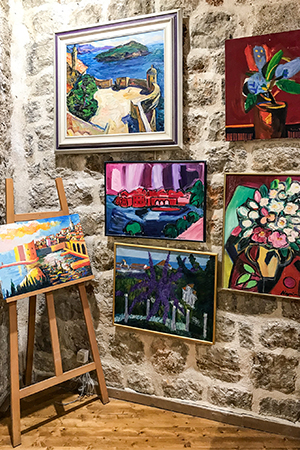
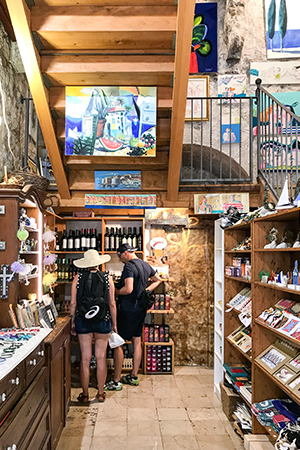
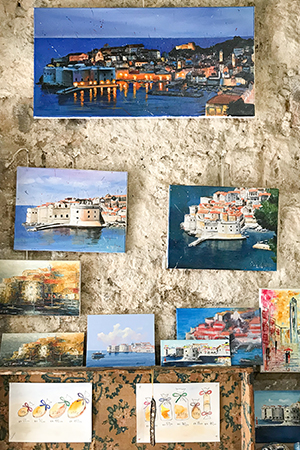
“I like to splurge on special experiences when I travel. That might be a 7-course tasting menu at a Michelin starred restaurant, or a private yacht charter for a day of island hopping. These experiences are always with me, require no extra luggage or space in my apartment, and are my favorite travel keepsake. I also love to admire the work of local artisans. From sculpture and pottery, to fine art or jewelry. I enjoy browsing art shops, galleries or craft markets. Supporting the work of artists not only helps to keep alive local traditions, but directly support the local economy. And I love having a one of a kind artifact. I might purchase something as a gift, or keep it for my person collection. I have traveled extensively but my heart is always in Croatia, and the warm people there who embrace joy and the pleasures of life.”
~ Tara Busch, Luxury Travel Designer
A Traditional Treat from the Island of Rab
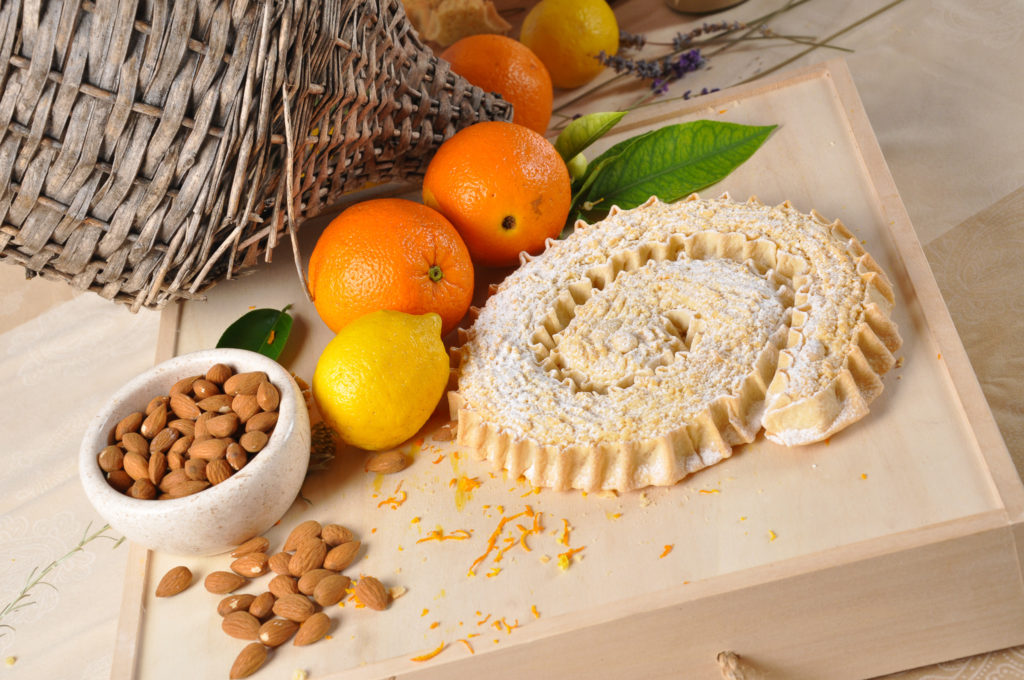
“Souvenirs are something we take as a memory back home from our travels, something that will remind us of the adventures we experienced along the journey. One of my favorite souvenirs from Croatia is actually one that you eat, but don’t regret.
I received this souvenir for the first time 15 years ago on my wedding day. That was the first time that I fell in love with “Rabska torta” (Rab cake), which was wrapped in a beautiful box with fine lace paper below the cake.
Not only it was the sweetest gift received and a taste to remember, but the story about it was the reason why I still keep it in my memories. Here is how the story goes; the legend says that it was mentioned for the first time back in the 12th century (yes, you read that correctly, the 12th century!) when it was served for the first time to Pope Alexander III while he was visiting Rab. The cake was created then by the Benedictine nuns whose original recipe was for centuries passed on to new generations and is still kept in writing in St. Andrew’s monastery on the island of Rab. Nowadays, local women on Rab prepare this delicacy following the same ancient original recipe.
Rab cake is much more just a cake, it is a true delicacy whose production takes up to several days. With its central ingredient, almonds, and a touch of authentic Maraschino liqueur, together with lemon zest and other tasty ingredients, Rab cake has become one of most well-known original souvenirs from Rab, as well as a special daily treat for the locals.”
~ Mirela Benic, Tasteful Croatian Journeys In-Country Concierge
Traditional Croatian Textiles
As a first generation American of Croatian descent, the souvenirs I bring back from Croatia hold a special significance that goes beyond mementos of my travels. They are tangible connections to my roots. My childhood home was filled with Croatian art and cultural artifacts such as my mother’s tablecloths stitched in traditional Croatian patterns and my father’s cap from the Lika region from which his ancestors hail. From woven wool table runners to lace pillow covers, I enjoy showcasing my culture in my home.
When I travel to Croatia, I enjoy selecting handmade one-of-a-kind home accessories and textiles reflecting the country’s culture and traditions inspired by the artistry and beauty of Croatian embroidery (Vez) and lacemaking (Cipka) traditions.
Silk embroidery (poprsnica) and woven textile patterns from the Konavle region of Croatia feature symmetric and geometric patterns primarily in red, black, and dark green with yellow/golden borders stitched in silk thread. The production and rearing of silkworms in the Konavle region dates back to the 11th century. To purchase truly unique gifts of Konavle embroidery and woven textiles visit Kokula Art and Craft Shop, Đorđićeva 6, Dubrovnik, Croatia or AR Atelier 20215, Gruda, Croatia founded by artist Antonia Ruskovic Radonic a native of Konavle.
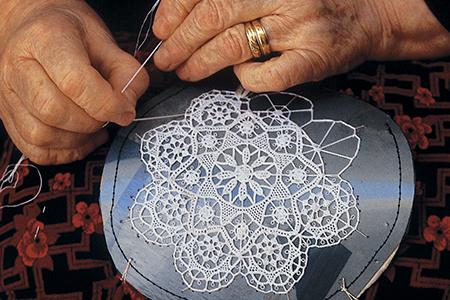
Croatian lacemaking, a UNESCO Intangible Cultural Heritage of Humanity, is concentrated on the Dalmatian islands of Hvar and Pag and the town of Lepoglava in Northeastern Croatia. Hvar lace, made with threads of the agave leaf has been made in a Benedictine monastery since finding its way to the island by seafarers from Tenerife Spain in the 19th century. To purchase unique gifts inspired by traditional Croatian lace making, visit Takemehome for homewares featuring Croatian lace and other unique handmade products Tomićeva 4, Zagreb or Chypka for streetwear with a unique Croatian lace flare, located in the Hotel Jagerhorn, Ilica 14, 10000, Zagreb or visit Sopar Collection the brainchild of two sisters from the island of Pag, for women’s fashion featuring handmade lace from Pag. Purchase online or by appointment +385919703065 at their showroom Šestinska cesta 19a, 10 000 Zagreb.
 |
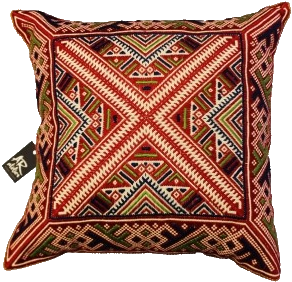 Photo with permission from AR Atelier |
|
 Photo with permission from Chypka |
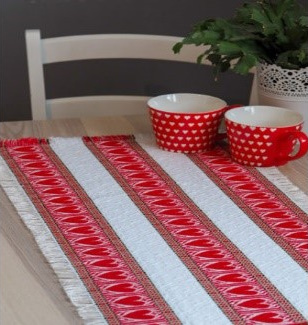 Photo with permission from Etno Motiv |
~ Melita Krstulovic Opara
Tasteful Mementos from the region of Istria
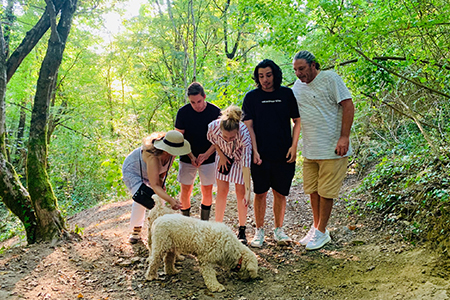
“Souvenirs are an exciting way to bring back a bite sized memory from your travel adventures. Every time I visit Croatia, I am keen on bringing back my favorite souvenir: Croatian Truffle Balsamic Vinegar and Olive Oil.
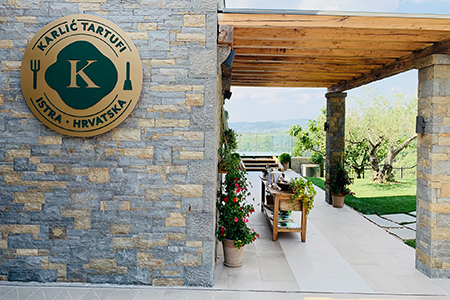
My family and I visit Croatia every year and for the first time in 2018, we made our way to the Meneghetti, our new favorite winery and luxury hotel. Wanda and her team suggested we visit the region of Istria due to its fabulous wine, truffles and culture. We were informed of Karlic Tartufi located a short distance away from the hotel and learned about the wonderful dog truffle hunt they offered. Wanda knows everything about this region and all it has to offer and made sure to prepare an itinerary for us that included all the best places!! We had the most amazing experience and ended up buying their truffle olive oil and balsamic which was fabulous! We have been enamored with it ever since and every year when we visit, we return to Karlic Tartufi to get our favorite olive oil and balsamic. Fresh, exceptional, and tasteful food is an integral part of Croatia and we love the chance to bring a piece of it home with us each year. When we drizzle that truffle olive oil and balsamic on fresh bread while back in the US, it immediately transports us right back to vacation in Croatia!
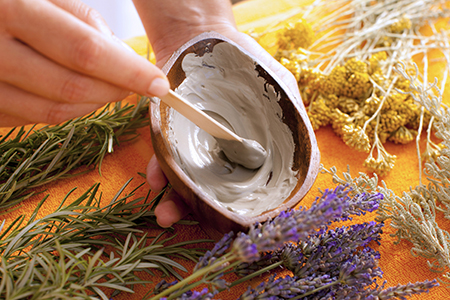
Croatia has so many wonderful souvenirs that are unique to the country’s culture. When visiting, be sure to pick up some special items such as fresh lavender, handmade doily’s, traditional folklore dolls or your own favorite olive oil & balsamic! Thank you, Wanda and team for your itinerary and thoughtful planning!”
~ Maxime Menne, Traveler & Friend
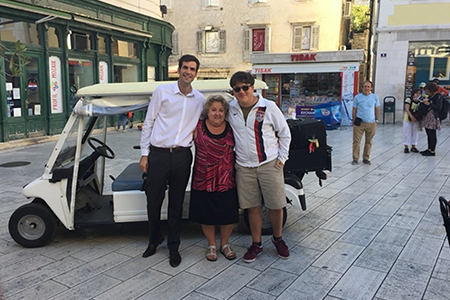
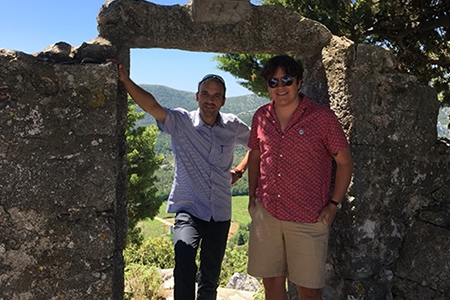
Trinkets Which Trigger Memories
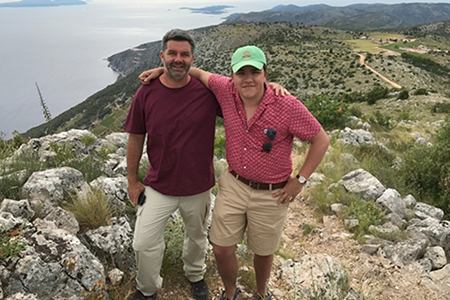
“During my first two trips to Croatia I bought a lot of souvenirs. Soccer jerseys, refrigerator magnets, olive oil, clothes, little pieces of craftsmanship that still make grin when I see them tucked around the house every day.
It wasn’t easy to pick just one. There’s a miniature ship made of olive wood that I bought in Korčula that I have placed on the credenza in my living room that holds a lot of my affection. My mom has a painted wooden panel of Split’s waterfront that I see every day that makes me remember the visceral joy of walking around that impossibly charming town. Pretty ceramic pomegranates, pieces of gorgeous lace, small pieces of woven silk, and whatever olive oil we could get our hands on.
All of those things are lovely, tiny crumbs of the country that I love that made their way onto the flight back to Chicago with me, but they are not what I value most. What I treasure most is what I cannot bring back, and what makes me pine for a return more than anything; the people. The memories of their faces are what moves me more than anything. A degree of generosity that we take for granted here in America. Faces that ooze with pride for their country, and a desire to share a little slice of their Adriatic paradise with people from all around the world. Faces that know that the best things are valueless if they aren’t shared.
That’s my favorite souvenir: the memento that I tell people about more than anything else.”
~ John and Bina Oremus, Tasteful Croatian Journeys repeat travelers
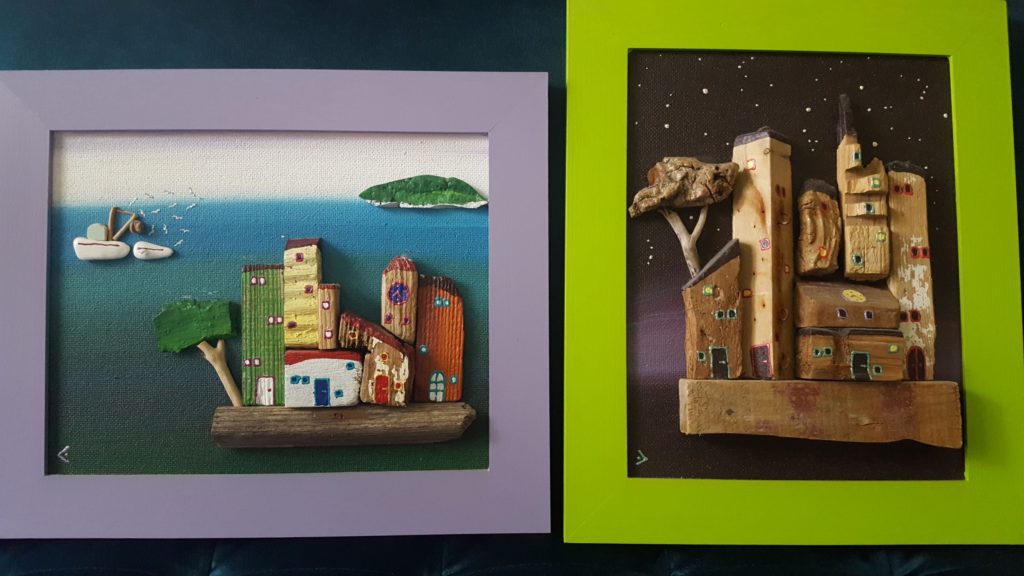
Driftwood Art x Nature
I’ve known Wanda for many years. Our relationship is one of kismet; we met at a perfect time in each of our lives. Of our many shared passions is a mutual admiration of fine craftsmanship.
I simply love unique and handcrafted pieces of art. I especially love when the artist incorporates raw elements of nature, such as driftwood, into their craft.
The art pieces pictured above were discovered within Diocletian’s Palace in Split. Upon purchase, these two pieces were titled Day/Night, however I was inspired to name them Seascape (purple frame) inspired by the region of Dubrovnik and Starry Night (green frame)which depicts Split at night. These two pieces have such incredible multi-dimensional detail. The entire canvas is crafted with individual pieces of driftwood. The selection of varied sizes, colors, arrangement and most impressively, the particular attention to detail in each piece to create the scene. My favorite feature are the micro-pieces of driftwood to craft sea gulls over the fishing boat.
I’ve been collecting driftwood art from Croatia for 20 years, I never get bored and just love how complementary they are to any space.
On my frequent trips to Croatia, I also have several items which I purchase regularly. Hands down, NO trip is complete without picking up the following items:
- Rakija – This is a must have in one’s cupboard. Rakija is a multifaceted liqueur. A brandy made from any variety of fermented fruits or potato; it is as common as a cup of coffee. Rakija seals any occasion – weddings, funerals, football matches (teehee) – and is undoubtedly embedded in our culture… And as an added bonus, it boasts excellent health benefits too (helping circulation, colds, stress, healing bruises, and aiding in digestion)
- Lavanda – Fresh or as an Essential Oil. Lavender is essential for my well-being. Not only is it excellent for relaxation, skin, sunburns, and repelling bugs…it smells AH-amazing! I always stock up and share with family/friends. To boot, Croatia is one of the top producers of pure, unadulterated Lavender in the world. We’re so spoiled!
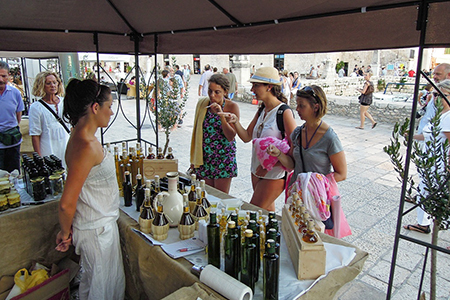
- Olive Oil – No salad or fresh hot bread is complete without Olive Oil, especially from olives grown from the rich soil and salt air of Croatia. Each region has a unique taste; my favorite is from the island of Brac. Perfect color, consistency, and titillation to the palate. My mouth is watering just writing this.
Of course there are other AMAZING delights like Wine, Cheese, Prosciutto, Wool, Cotton…I could go on. What can I say – I relish in anything Croatian. I can’t help it; it’s really, really great quality and highly recommended. Zivjeli!
~ Tanya Fable, Event Producer and Inquisitive World Traveler
Croatian Locals Making an Impact
It is not difficult to fall in love with Croatia; it is a country home to many seductions – the shimmering Adriatic, pristine national parks, captivating medieval cities, fresh local food, and rich history. So often, these are the things that inspire our travelers to visit Croatia in the first place. But regardless of whatever temptation initially brought them there, many travelers come home surprised by the same revelation:
It was not just the charming towns, turquoise water, and delicious food which made the trip memorable, but the friendly locals who left the most lasting impression.
This is a sentiment we understand and relate to.
Tasteful Croatian Journeys Founder and President, Wanda S. Radetti, has always been a firm believer in the power of personal connections made through travel. “Travel is about people… it is my mantra… it is about loving, caring for, and respecting all people. It is about pleasures and newfound joys in new friendships. It is about expansion of mind and heart!” Wanda’s philosophy is woven throughout the itineraries she designs and a primary focus of the Tasteful Croatian Journeys team. We strive to facilitate the connections that lead to extraordinary, expectation-exceeding travel.
With that in mind, we seek out relationships with talented, passionate professionals who embody those same values. We endeavor to enrich our guests’ travel experiences by introducing them to our vast network of locals living in Croatia, whether that be a guide, a driver, a chef, or a hotelier. We are proud to call these individuals colleagues and friends, and proud to share their stories here.
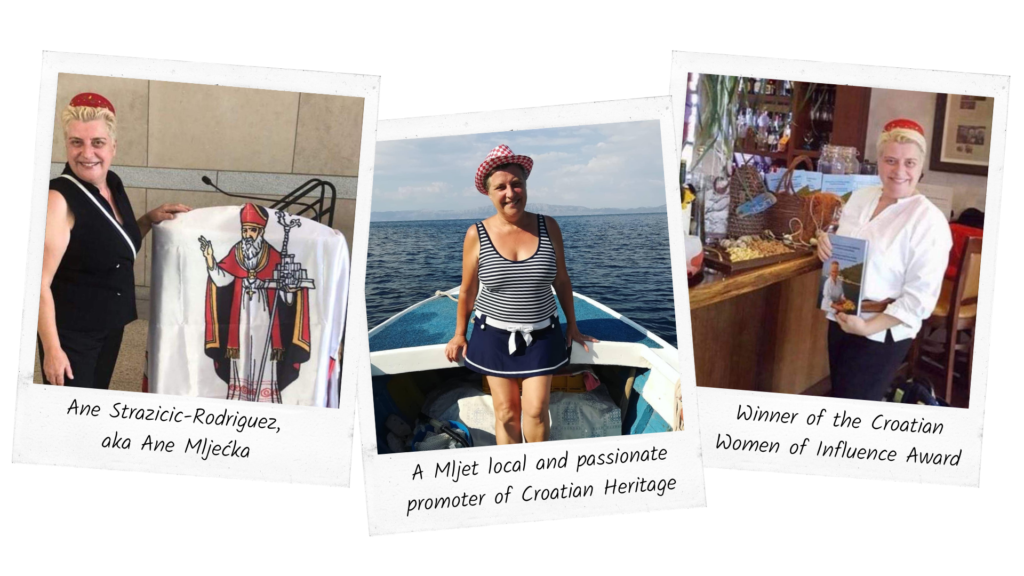
Meet Ane from Mljet
Wanda first met Ane Stražičić-Rodriguez (or Ane Mljećka, as she is often referred) more than ten years ago at an Easter party in New York City. Wanda, who was born in what is now the northern Croatian city of Rijeka (then Fiume, part of Italy), and Ane, a southern Dalmatian woman from the island of Mljet, quickly became friends. They shared a mutual love and passion for their beautiful home country, something that they each brought with them to their adopted homes in the United States, and something which has, in different ways, steered the courses of their careers.
Like so many Croatians at home and abroad, Ane retains a strong connection to her birthplace and tremendous pride for her country, and more specifically, her island. She has devoted herself wholly to promoting her home and heritage… and who can blame her! Mljet is, by all accounts, a little piece of paradise. Often referred to as Croatia’s greenest island, one third of Mljet is protected national park territory, home to unspoiled nature and tranquil azure bays. The remaining two thirds of the island really isn’t much different, retaining a wild beauty and casual romanticism not often found in the contemporary world.
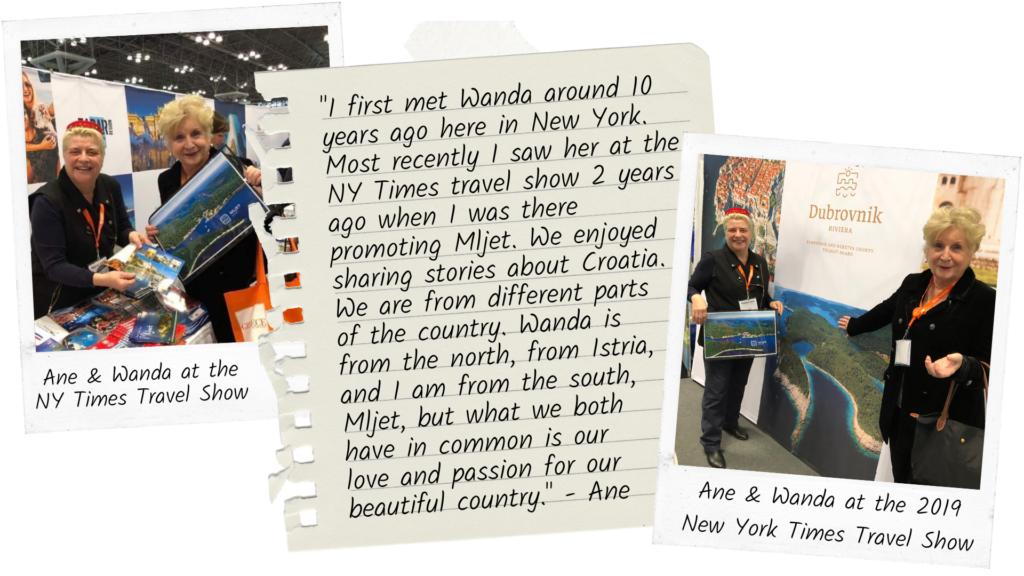
Of her brethren, she boasts, “We are not people, we are Mljetans!” She describes the people of her island as hard-working and big-hearted, doing all they can to do good in the world. It’s a description which seems to fit. Ane spends a good portion of her time promoting Croatia’s cultural heritage and gastronomy. She organized an exhibition of traditional embroidery from Mljet, Konavle, and Dubrovačko Primorje in both New York and Chicago. She petitioned to save Mljet’s mongoose population from extermination (once introduced to control the snake population, they have since been considered invasive to the island’s native animal population). She is currently pursuing officials to grant Mljet UNESCO status… The list goes on.
In 2013, she wrote a cookbook, “From the Kitchen of Ane from Mljet: Traditional Croatian Cuisine from The Region of Dubrovnik,” featuring recipes for healthy Mediterranean dishes. She is currently offering cooking classes and working on her second cookbook, a joint project with her friend, Tanya Bistre. Tanya is originally from the region of Istria, a well-known foodie destination, renowned for its delicious truffles. Together, they are compiling a book of recipes highlighting dishes from around Croatia, while also paying tribute to its autochthonous wines.
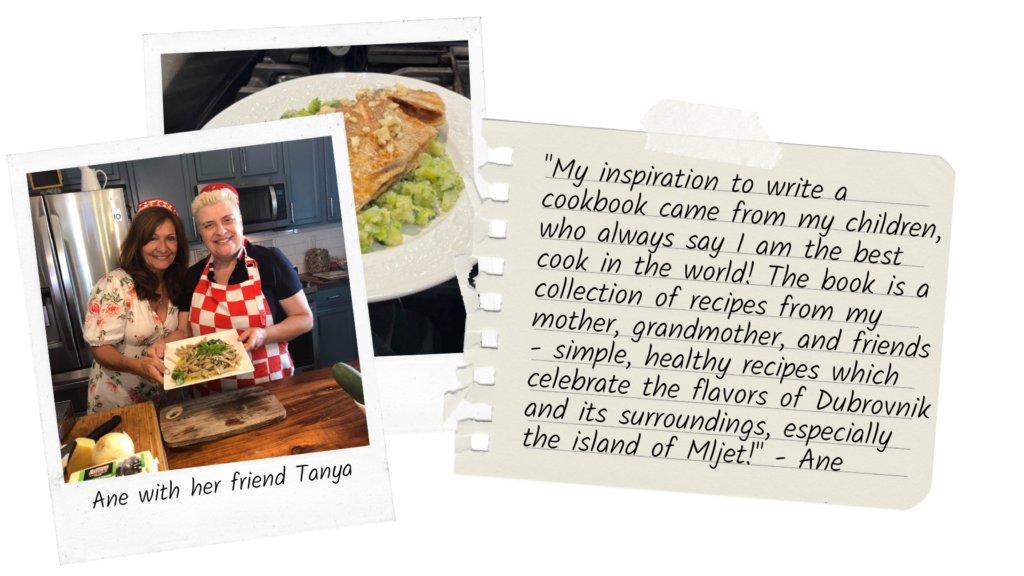
In addition, Ane is an active volunteer, fundraising for humanitarian efforts across Croatia, wherever help is most needed. Her hard work has not gone unnoticed. In 2020, Ane received the Croatian Women of Influence Award, being recognized by the Croatian Women’s Network for her leadership, innovation, and community impact. The 23 award recipients were chosen from more than 140 nominations across 10 countries. She also received an award from the Croatian World Congress USA (Hrvatski Svjetski Kongres USA), an organization of Croatian expatriates, for her work promoting Croatia and its islands. However, her most prized accolades do not come from organizations, but from the people of her island. “Of everything I’ve received, the most important for me are the songs that were written for me by Mljetan poets. To be an inspiration to someone, especially to a poet from my island, is priceless.”
As you may have guessed, Ane’s network is wide and far reaching. She maintains contact with Mljetans and their descendants across the globe from her home in New York. She, like so many others from her island, do not actually live on Mljet anymore. In fact, the island currently has a population of just over 1000 people. “You can find Mljetans all over the world, many more than in Mljet actually – but America has the most!” Mljet native Ivo Dabelić wrote a book, Mljetans in America, chronicling the contributions of these Mljetan immigrants in their new country. The accounts are wide and varied, starting from the year 1790 and touching every part of American history, from westward expansion to World War II. Immigrants from Mljet were digging for gold, working in Californian mines, and building railways. Many of them were engaged in the hospitality industry, owning restaurants, hotels, and bars. Brothers Frano and Nikola Kastelan were pioneers in the fishing of salmon in the state of Washington; Ilija Dabelic was a volunteer soldier in the Civil War; Jack Claudius Hazdovac was a sailor on the U.S.S. Arizona, which was sunk in Hawaii during the bombing of Pearl Harbor on December 7, 1941.
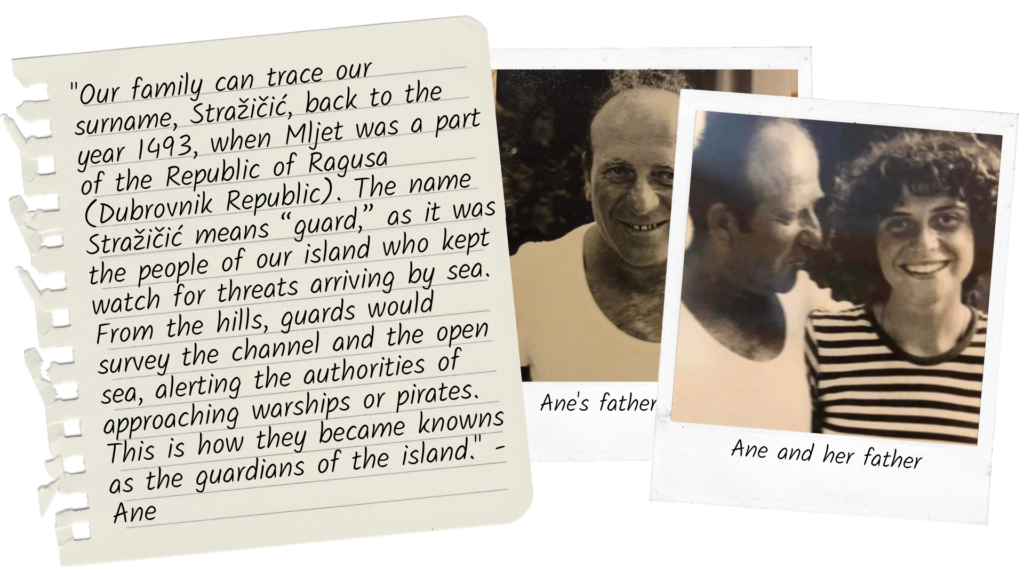
Ane can trace her own family and the Stražičić name back to the fifteenth century guards employed with protecting Mljet when it had been annexed as part of the Republic of Ragusa (Dubrovnik Republic). The Stražičićs she has connected with in America all come from that same family, from the hilly village of Goveđari on the western side of the island. “Even though they mix with Americans and different nationalities through marriage, that drop of Stražičić blood keeps them together and makes them proud to be Mljetans. Most Stražičićs in America, and most Mljetans in general, live in California. A cousin of mine has been organizing a Stražičić Family Picnic out there for many years. There are about 200 relatives who get together every year. Even with just few drops of Stražičić blood, they consider themselves Stražičićs, and it binds us together in celebration of our heritage. We Mljetans, and we Stražičićs, are very proud of Croatia, the country that we come from, and our Mljet. We will always keep it in our hearts. But we are also proud of our new country, America, where our dreams come true.”
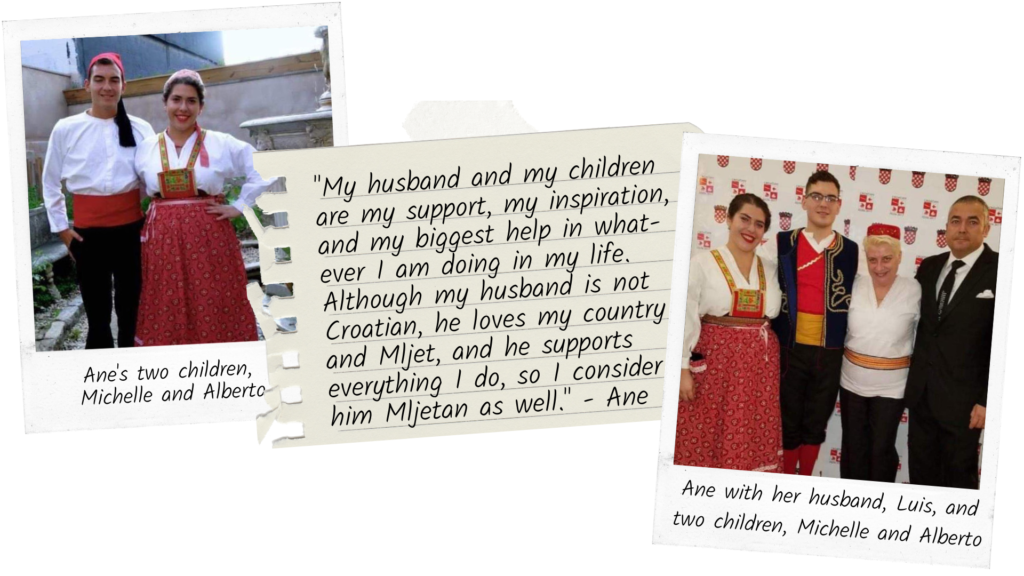
Ane’s own “American Dream,” began in the 1980’s when she, like her great-grandfather before her, set out for the United States. She settled in New York, where she met and married Luis A. Rodriguez, a handsome Puertorriqueño and professional chef. Together, they have two beautiful children, Michelle Ramonita and Alberto Ilija. Ane and Luis instilled in their children a deep love of their three homelands – the United States, Puerto Rico, and Croatia – and raised them tri-lingual, speaking English, Spanish, and Croatian. Alberto is a Marine Ingeniero and officer in the US Coast Guard. Like many Mljetans who are traditionally sailors, he became one too. Michelle’s love of Croatia runs so deep that she decided to return to her mother’s home country to pursue a career in tourism there. Ane’s husband and children support her fully in her efforts to promote her Croatian heritage and homeland. They are the driving force behind everything she does.
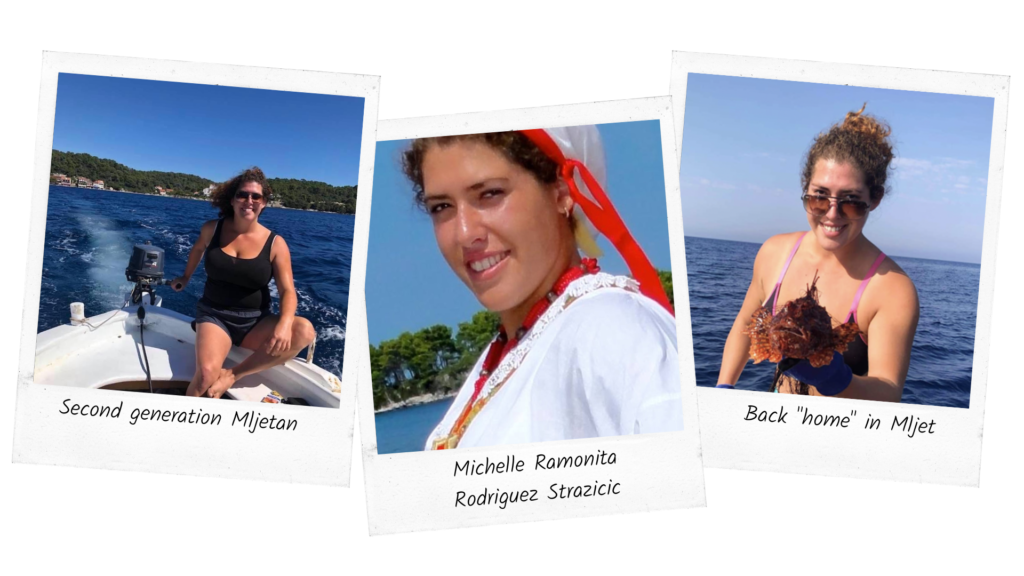
Meet Ane’s Daughter, Michelle
Michelle Ramonita Rodriguez Stražičić is following in her mother’s footsteps, promoting the island of Mljet and working in the tourism industry.
In 2015, Michelle made the decision to study International Hospitality and Service Management at RIT Dubrovnik, a global satellite campus of the Rochester Institute of Technology and the only higher education institution in Croatia which grants both American and Croatian degrees. Although she had not originally planned to attend college so far from home, she ultimately fell in love with the prospect of studying tourism in her second home. RIT offered not only the major she was looking for, but a small campus experience that was very appealing to her.
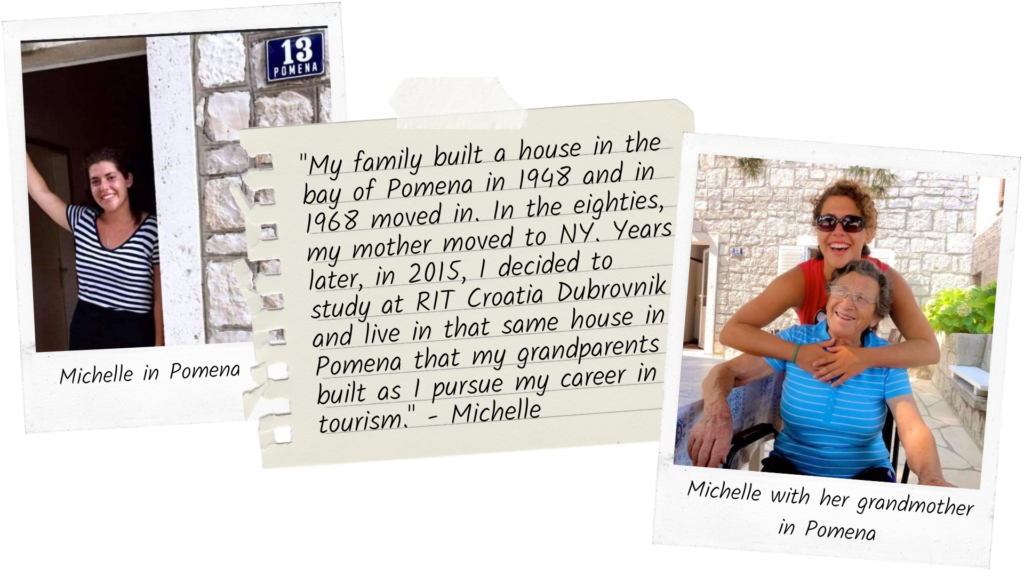
Her inspiration to pursue a career in tourism came from summers spent in Mljet helping with the family business. The Stražičić family had built a fishing house in the bay of Pomena in 1948 and in 1968 moved there to engage in the island’s tourism. This came about 8 years after that part of the island was granted National Park status. Michelle’s grandparents (Ane’s parents) had a little pension where they catered to tourists, serving freshly caught fish and lobsters, homemade wine, grappa, olive oil, goat cheese, and prosciutto, and organic fruit and vegetables from their farm. Working at the pension, Michelle found that interacting with the travelers became much more than just a job. It was an opportunity for her to share her love of Mljet and show visitors the island through her eyes – an enchanted place with ancient legends, rich history, beautiful nature, and warm people.
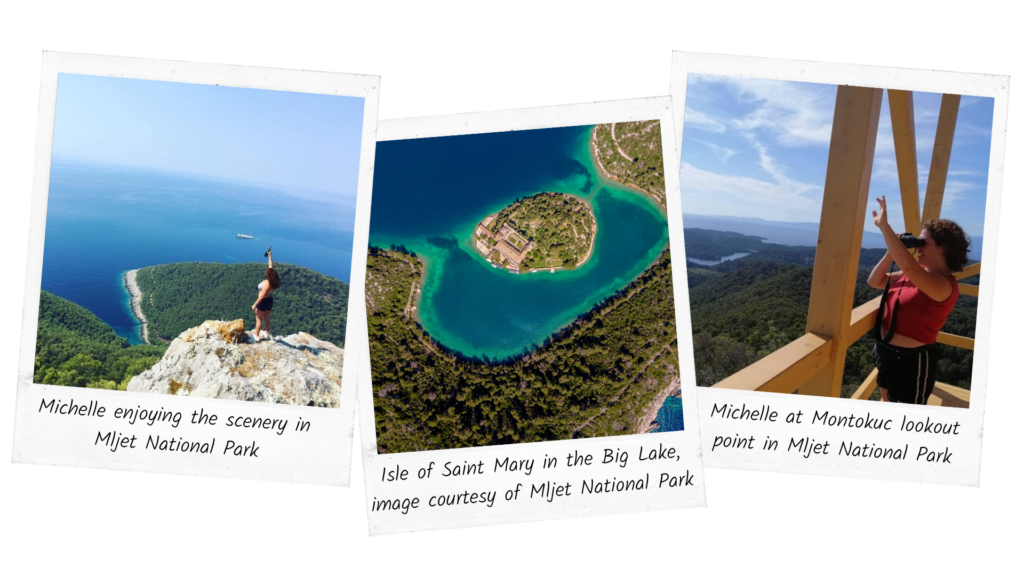
After graduation, Michelle decided to move in to her family’s home in Pomena, the same house that had once been home to her mother and grandparents. From there, she first worked for Mljet National Park before switching to a private company offering tours around the island. Through Michelle, a Croatian-American girl living in paradise, Tasteful Croatian Journeys is happy to provide insider knowledge and access to one of Croatia’s most stunning islands.
 About the Author:
Luxury Travel Designer and Destination Specialist, Tia Lovisa Moreira, Joined the Tasteful Croatian Journeys Team after nearly a decade spent living abroad in Munich, Germany. Having traveled to more than 40 countries across 4 continents, she brings with her a wealth of first-hand travel experience and a deep love of European peoples and cultures. Learn more about Tia here.
Croatia’s 5 Most Beautiful Beaches
If you are craving a little vitamin sea, look no further than sunny Croatia! With over 1,000 miles of pristine coastline and more than 1,200 islands sprinkled throughout the Adriatic, this enchanting country has plenty to offer in the way of stunning natural beaches. From white sand lagoons on far-flung islands, to hidden pebble coves framed by towering cliffs, Croatia has a beach for every taste. Tasteful Croatian Journey’s team of luxury travel designers and destination specialists have scoured the country to find its very best beaches. We have searched far and wide to compose this list of idyllic escapes that aren’t just beautiful, they’re bucket list worthy! Each one is different and completely unique – an example of the astonishing variety to be found in Croatia – but what they all have in common is their jaw-dropping scenery and magnetic allure.
Get your cameras ready and prepare to be the envy of Instagram, because here are the 5 most breathtakingly beautiful beaches in Croatia…
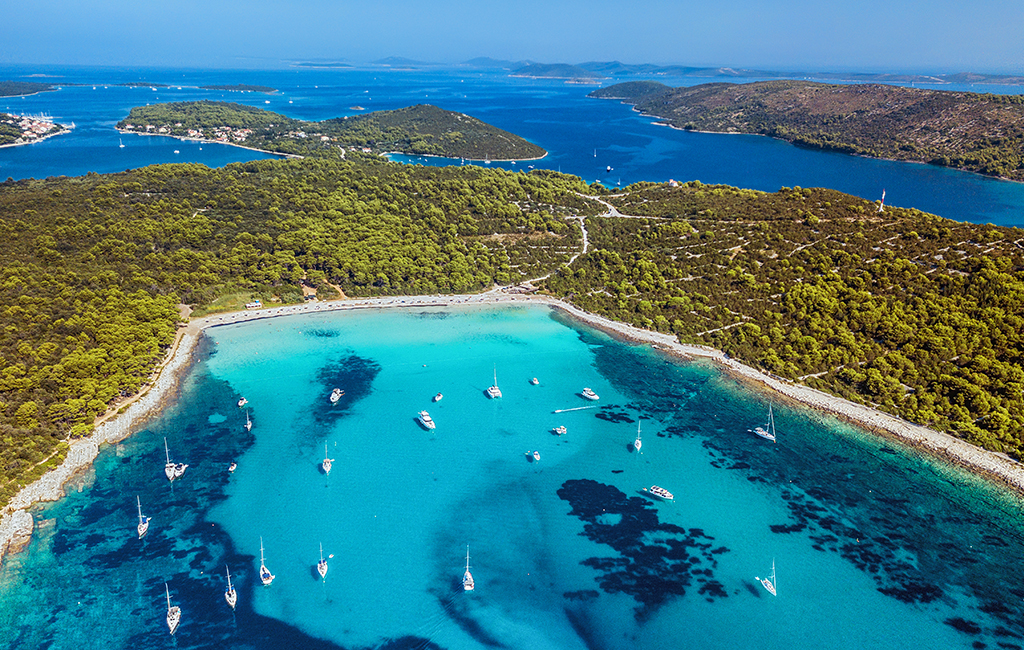
5. Sakarun Beach
White sand and shallow waters on Dugi Otok Island
The rugged southern coast of Dugi Otok Island, home to the Telašćica Nature Park and gateway to the Kornati Islands, recently graced the cover of the April 2021 issue of Conde Nast Traveler, inviting readers to “Sail Away to Croatia” and bringing recognition to a little-known island still largely off the radar of most American travelers.
Nicknamed, “Long Island,” Dugi Otok is a slender stretch of land marked by great geographical diversity and contrast. In the south, you’ll find the magazine cover cliffs and raw, untamed nature. In the north, quiet coves and tranquil beaches, the most famous of which is Sakarun Beach. Known for its beautiful white sand (a rarity among Croatia’s mostly pebble beaches) and pristine turquoise waters, the half-mile long Sakarun Beach gives off some seriously Caribbean vibes. The beach is made up partially of smooth white stones, which make way for fine white pebbles, and finally pure white sand closer to the water’s edge. The sea floor is completely sandy, lending to the incredible turquoise hue of the water. The shallow bay faces south, inviting visitors to wade and bathe in the crystal-clear waters while enjoying unspoiled views of the open sea and the uninhabited western coast of the island. Some distance out, past a rope divider, sailboats and motor yachts drop anchor as happy passengers splash off their bows. Several small beach bars cater to visitors, offering refreshments and light meals as well as sun loungers and umbrellas for rent. Cradling the bay is a thick pine forest, giving the illusion of complete seclusion from the outside world. In reality, the nearest villages are no more than a bike ride away, with Božava, the largest, offering a miniature train to transport visitors back and forth from the beach. Parking is also available for those who choose to drive, however we recommend visiting by private yacht excursion from Zadar instead, as ferry connections can often be complicated and time consuming.
Sakarun Beach Overview
Also known as: Saharun Beach
Location: Dugi Otok Island
Nearest villages: Veli Rat, Verunić, Soline, and Božava
Nearest major city: Zadar (mainland)
Beach type: small pebbles and sand
Chairs & Umbrellas available for rent: yes
Facilities available: restroom, several beach bars offering refreshments, snacks, and light meals
Best way to visit: private yacht or speedboat – arrive in style and without the inconvenience of adhering to a ferry schedule!
4. Pasjača Beach
A hidden gem on Konavle’s coast
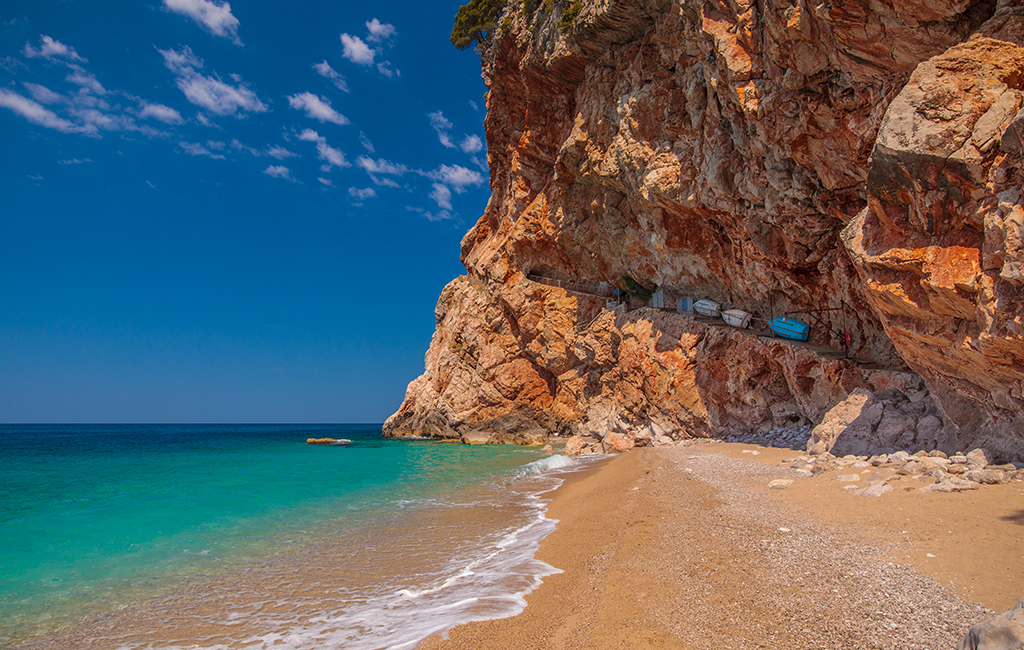
A trip to Pasjača Beach is not for the faint of heart! This picture-perfect beach can only be reached by a concrete foot path which hugs a sheer cliffside and descends more than 800 feet to the shore below. Precarious at times, the path winds downward, passing through a narrow tunnel carved into the rocks before ending in a combination of steps and stones… but however daunting this may seem, don’t be put off. Those who make the difficult trek will be rewarded, first by the spectacular viewpoints along the path, and next by the cool clear water lapping the shore.
Located in the municipality of Konavle, roughly 20 miles south of Dubrovnik, Pasjača Beach was formed through the marriage of man and nature. In 1955, a tunnel was built from an inland stream leading to the sea. The intention was to prevent the frequent flooding of nearby fields. The rocks that were excavated during the tunnel’s construction were discarded on the shore. Over time, the sea worked its magic, pounding the rocks into fine sand and creating this one-of-a-kind beach.
Although small in size, Pasjača Beach is impossibly picturesque, with a narrow strip of sand the only separation between imposing cliffs and translucent sea. Massive rocks in the water invite swimmers to sunbathe atop them and take in the rugged beauty which surrounds. Difficult to access, and with no facilities or amenities of any kind, Pasjača Beach attracts adventurers seeking an off-the-beaten-path oasis for relaxation and quiet. However, having been named the “Most Beautiful Beach in Europe” by Brussels-based tourism organization European Best Destinations in both 2019 and 2020, this once unknown beach may soon find increased crowds, so be sure to visit as soon as possible!
Pasjača Beach Overview
Location: Konavle Region
Nearest villages: Popovići
Nearest major cities: Cavtat, Dubrovnik
Beach type: sand, rocks, and gravel
Chairs & Umbrellas available for rent: no
Facilities available: none
Best way to visit: private car and driver – there’s no need to rent a car in Dubrovnik, as the city’s main sights are within the pedestrianized Old Town. Instead, hire a chauffeur for the day and stop at the beach for a few hours before exploring the surrounding region of Konavle.
3. Podrače Beach
Proof that Paradise Still Exists on the Makarska Riviera
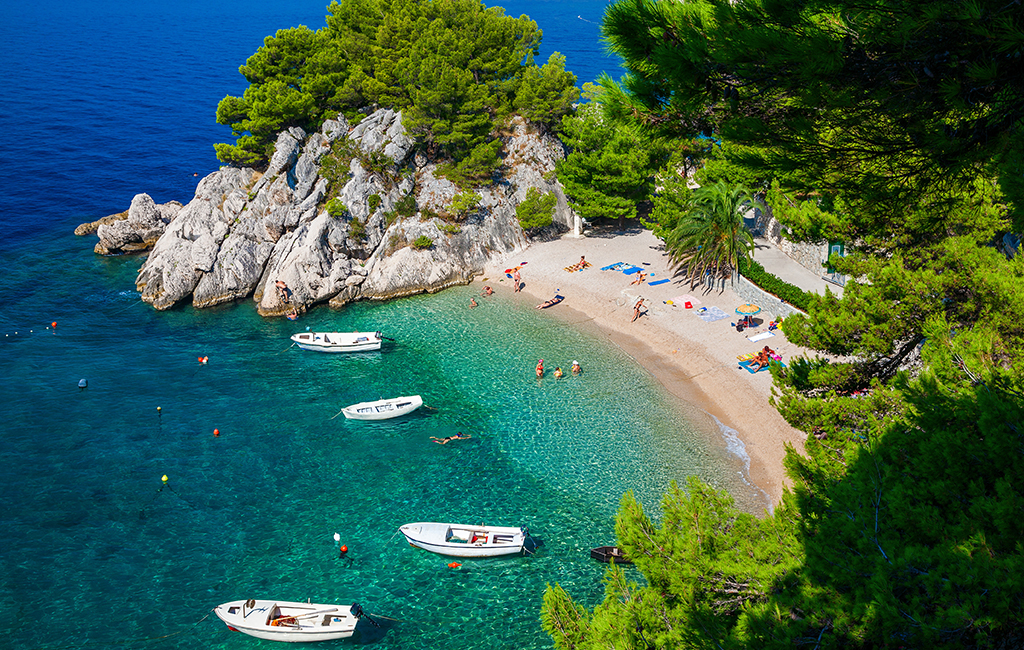
Postcard perfect Podrače Beach is one of the most photographed beaches in all of Croatia, and it’s not hard to see why! Mesmerizingly beautiful, the small pebble cove looks out upon shimmering jewel-toned water. Pine trees and tamarisks provide natural shade, protecting beach goers from the sweltering summer sun. In the distance, the Dinaric Alps prove a dramatic backdrop, sandwiched between the intense blue of sea and sky. Podrače Beach’s most notable feature is the large rock which forms a border at one side. The rock’s peak was once used to harvest salt by locals, who would evaporate seawater in its shallow pools. These days, it is simply an object of beauty to be admired, and sometimes, climbed.
This little slice of heaven can be found in the town of Brela, a seaside resort at the northern end of the ever-popular Makarska Riviera. Located between Omiš and the Neretva Delta (or more generally, between Split and Dubrovnik), the Makarska Riviera is a 38 mile stretch of coast home to several of Croatia’s most beautiful beaches and serving as a summer playground to sun and fun seeking tourists. Brela itself lays claim to roughly 4 miles of the riviera’s coast, boasting a lovely seaside walking path that links its chain of white pebble beaches. Within a short and pleasant walk from Podrače Beach, visitors will find the famous Kamen Brela (Brela Stone), a small rock island just off the shore, and the town’s main beach, Punta Rata. Also, along the promenade, an array of cafés, bars, and restaurants offer plenty of options for hungry beach goers to refresh and refuel. The entire area is wonderfully picturesque and a worthy excursion for travelers in need of a proper beach vacation.
Podrače Beach Overview
Often confused with: Punta Rata Beach (7 minute walk from Podrače Beach)
Location: Brela, Makarska Riviera
Nearest villages: Brela
Nearest major cities: Split
Beach type: pebbles and gravel
Chairs & Umbrellas available for rent: yes
Facilities available: showers, plenty of dining options within a short walk. No restroom on site.
Best way to visit: private car and driver – with no parking lot nearby, we recommend arranging chauffeured transfers to and from the beach. Even better, have your driver drop you off at the start of the seafront promenade and “beach hop” through the day, with pick up at your ending point.
2. Stiniva Beach
Towering Cliffs Hide an Unspoiled Cove on the Island of Vis
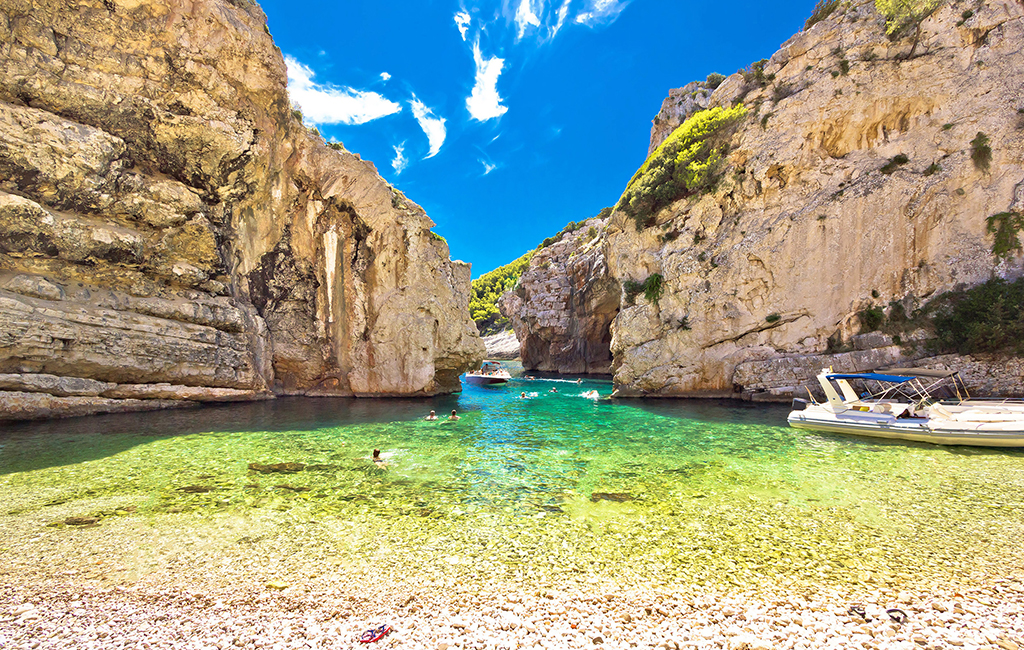
Located on the jagged southern shore of Croatia’s most remote island, Stiniva Beach is a place of striking natural beauty. From the sea, it is almost completely hidden by formidable cliffs which shield the alluring cove from passing boats. However, once through the narrow gate formed by the limestone bluffs, the inlet opens to reveal a stunning pebble beach surrounded by rocky wilderness. Shimmering blue-green water and dramatic views make this one of Croatia’s most instagrammable beaches, though the remote location and general inaccessibility mean that only the most intrepid travelers venture there. Most visit by boat, undeterred by the fact that half of the beach is always in the shade, a consequence of the steep limestone walls which encircle the cove. In the shaded area, a small tavern caters to thirsty beach goers who revel in the beauty that surrounds them.
This beautiful, isolated beach is just one of many charms to be found on the island of Vis. Seemingly untouched by time, Vis is brimming with rustic charm, from the quaint fishing villages along its shores to the quiet hamlets sprinkled throughout its interior. Vineyards and citrus orchards cover the hilly island, the scent of wild rosemary perfuming its air. Until 1989, Vis was completely shut off from the outside world, serving first as a hideout for Tito and his partisans and later as a Yugoslav military base. Even after opening to outsiders, the island still retains a calm difficult to find elsewhere, no doubt due in part to its remote location roughly 30 miles off the Croatian mainland.
Movie buffs may recognize Vis from Mama Mia! Here We Go Again, where it starred as the fictional Greek island of Kalokairi. Many of the island’s main attractions are highlighted in the film, including seafood restaurant Konoba Jastožera, famous for its fresh lobster. However, despite the increased attention garnered from the movie, Vis remains largely undisturbed; a haven for travelers seeking simplicity and authenticity.
Stiniva Beach Overview
Location: Vis Island
Nearest villages: Marine Zemlje
Nearest towns: Vis Town, Komiža
Beach type: Stones, pebbles, and gravel
Chairs & Umbrellas available for rent: no
Facilities available: one small tavern offering meals and refreshments
Best way to visit: private yacht or speedboat – unless you’re interested in a treacherous 20 minute foot path which literally follows a goat track, the sea is the only way to access this stunning hidden inlet.
1. Zlatni Rat Beach
A natural phenomenon on the Island of Brač
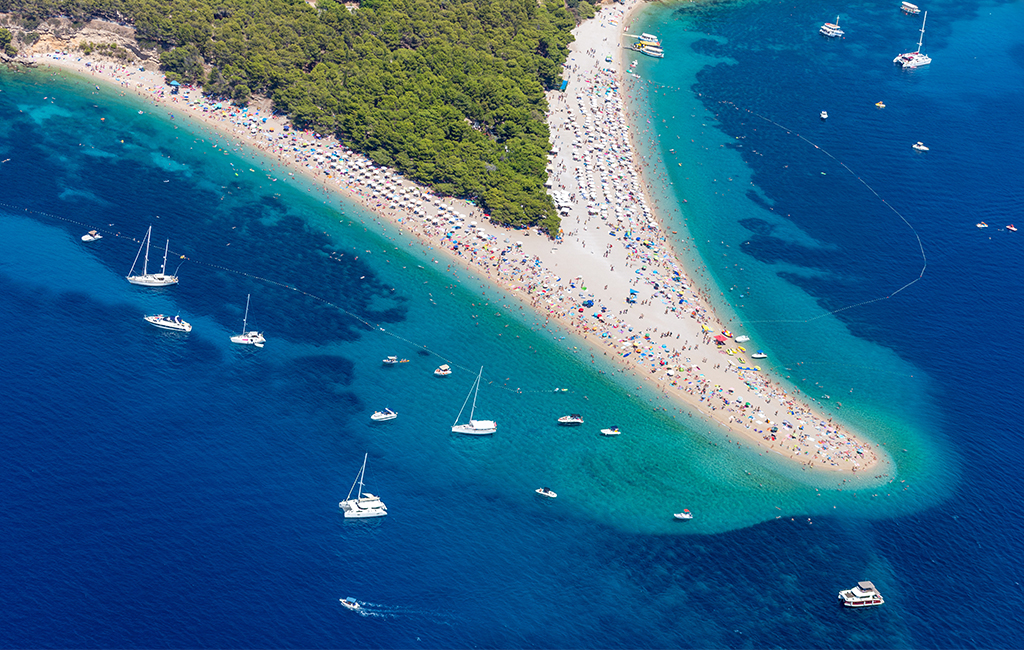
There may be no more unique beach in the world than Brač island’s spectacular Zlatni Rat. Extending into the sea like a lizard’s tongue, this geomorphological wonder has become one of the most recognizable icons of Croatia’s natural scenery and a must-visit location for sun-seeking travelers. Stretching more than 1,500 feet into the shimmering aquamarine waters of the Adriatic, this smooth pebble beach is in a constant state of change. The exact length and shape of the landform changes subtly with variations in the tide, current, and wind, making its shores every bit as alive as the people who visit them.
Zlatni Rat is also called the Golden Cape or Golden Horn. The moniker is thought to have been derived not from the color of its sunlit pebbles, but rather for the abundance of fish to be found in its waters; the main source of income, or “gold,” for local people. Here, on the southern coast of Brač, fishing has been an integral part of the local economy since the middle ages. Bol, the town closest to Zlatni Rat, was once the second most developed fishing settlement on the island. Today, it’s a buzzing summer hotspot, attracting crowds who wish to explore the surrounding area. A long promenade shaded by trees and elevated for stunning for views connects Bol to Zlatni Rat, however those that prefer to skip the 20-minute walk can also arrive at the beach via tourist train or taxi boat.
As Croatia’s most famous beach, Zlatni Rat benefits from well-established infrastructure. Sun loungers and umbrellas are available for rent. In addition, the center of the peninsula is pleasantly wooded, offering a shady retreat from the sun. Visitors are sure to be impressed by the array of activities on offer, from the massive aquapark floating offshore to parasailing excursions offering spectacular views. A strong “Maestral” wind that blows in the afternoon makes Zlatni Rat a favorite spot for windsurfing and kitesurfing, but mornings are calmer and perfect for families. All in all, this picturesque beach offers a little something for everyone. There is even a small nudist section of the beach, discreetly shielded by trees.
Zlatni Rat Beach Overview
Also known as: Golden Cape or Golden Horn
Location: Brač Island
Nearest villages: Bol
Nearest major cities: Split (mainland)
Beach type: small pebbles
Chairs & Umbrellas available for rent: yes
Facilities available: restrooms, showers, restaurants, playground, watersports… you name it, Zlatni Rat has it!
Best way to visit: private helicopter transfer – Zlatni rat’s unique shape is best viewed from above, so what better way to arrive to the island of Brač than by private helicopter transfer? Enjoy a scenic tour from bird’s eye view before heading off to enjoy the rest of your day at the beach.
About the Author:
Luxury Travel Designer and Destination Specialist, Tia Lovisa Moreira, Joined the Tasteful Croatian Journeys Team after nearly a decade spent living abroad in Munich, Germany. Having traveled to more than 40 countries across 4 continents, she brings with her a wealth of first-hand travel experience and a deep love of European peoples and cultures. Learn more about Tia here.